
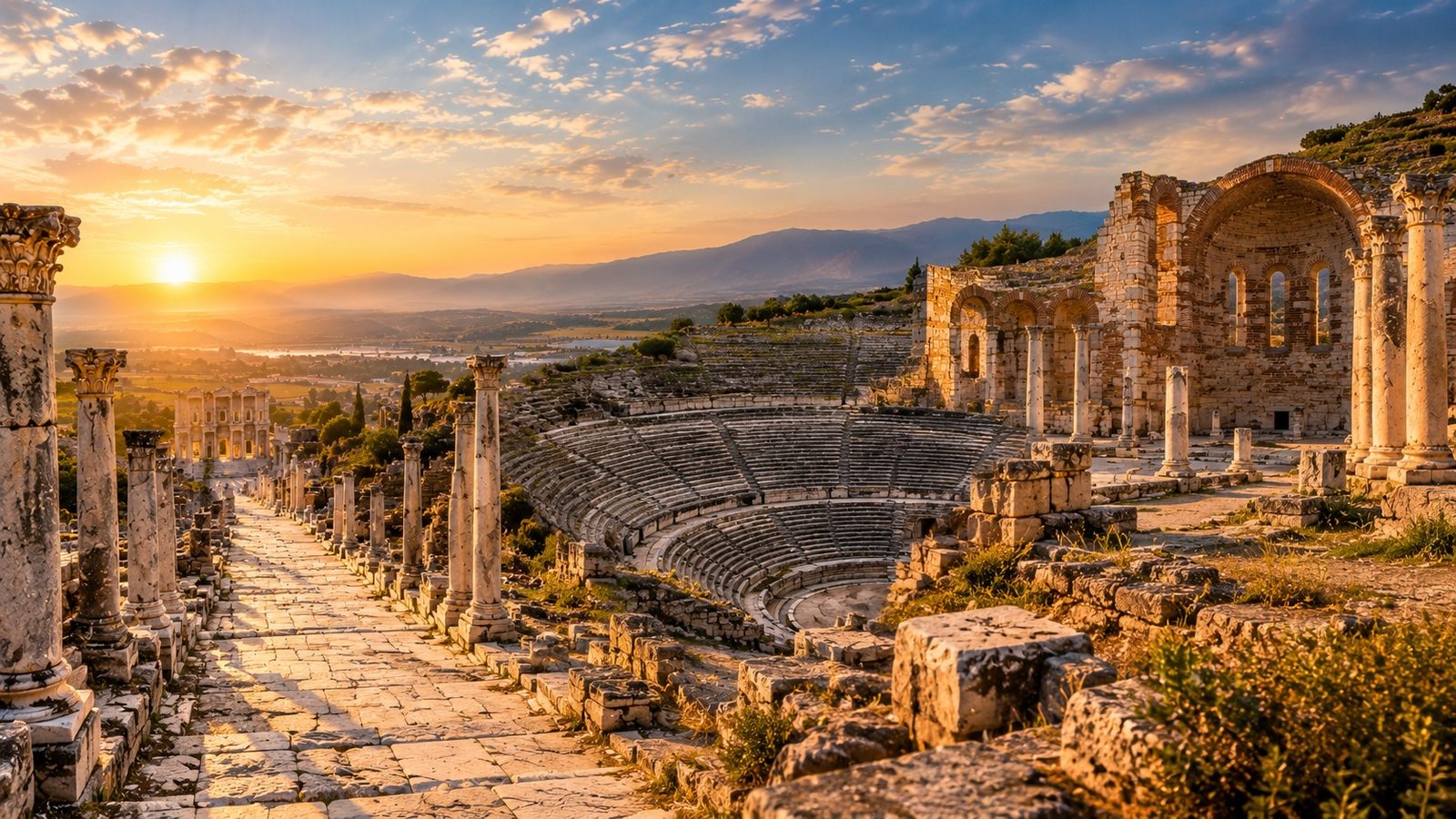
Is this your first time in Türkiye, or your hundredth?
Both are the right answer, and I mean that.
First-time visitors arrive with a list: Istanbul, Cappadocia, Pamukkale, Ephesus. It is a good list. It has been a good list for two hundred years, and we know how to build it well.
But something changes on the second visit. The list is finished, and the country begins.
So let me take the one site nearly everybody sees, and show what is in it that a coach morning cannot reach. Not because the coach morning is wrong — because it is ninety minutes, and Ephesus is not a ninety-minute place.
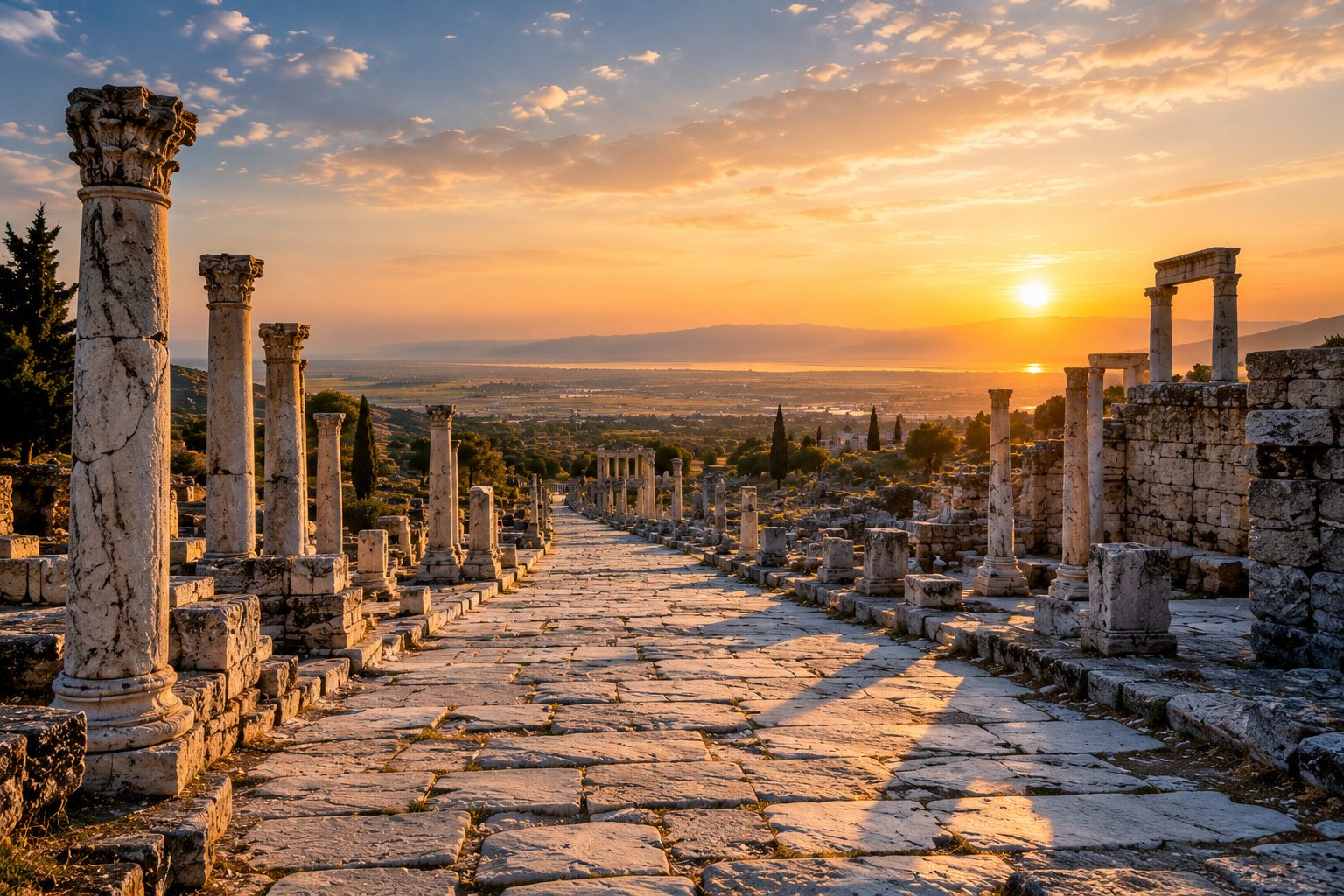
Why Ephesus is no longer on the sea?
Stand on the marble street that runs west from the theatre and you are looking down the approach to a harbour.
There is no water. There has not been water here for a very long time. The coast is now about six kilometres away, and between the ruins and the sea there is flat agricultural land that was, in the Roman period, a working port basin where ships tied up at the end of that street.
The river did it. The Cayster — today the Küçük Menderes — carried silt down into the bay season after season, and the bay slowly became land.
What I find harder to forget is that the Ephesians knew, and fought it, and lost.
Strabo tells the story of Attalus II of Pergamon, who judged that the harbour mouth was too wide for large ships and had a mole built to narrow it — reasoning that a constricted channel would scour itself deep. The opposite happened. The narrowed mouth trapped the silt inside, and the engineer who had warned him was proved right. Dredging was attempted again in the Roman period, and Hadrian is credited with an attempt to redirect the river itself. Each of these bought time. None of them won.
So the city that had been one of the great ports of the Mediterranean became a city with a marsh where its harbour used to be, and eventually a hill town remembering the sea.
Nothing in the marble tells you this. The stones are the same stones whether you know it or not. But once you do know it, the walk down that street changes direction: you are not walking towards a ruin, you are walking towards a shoreline that is not there any more.
Someone has to tell you. That is the whole job.
The theatre of Acts 19
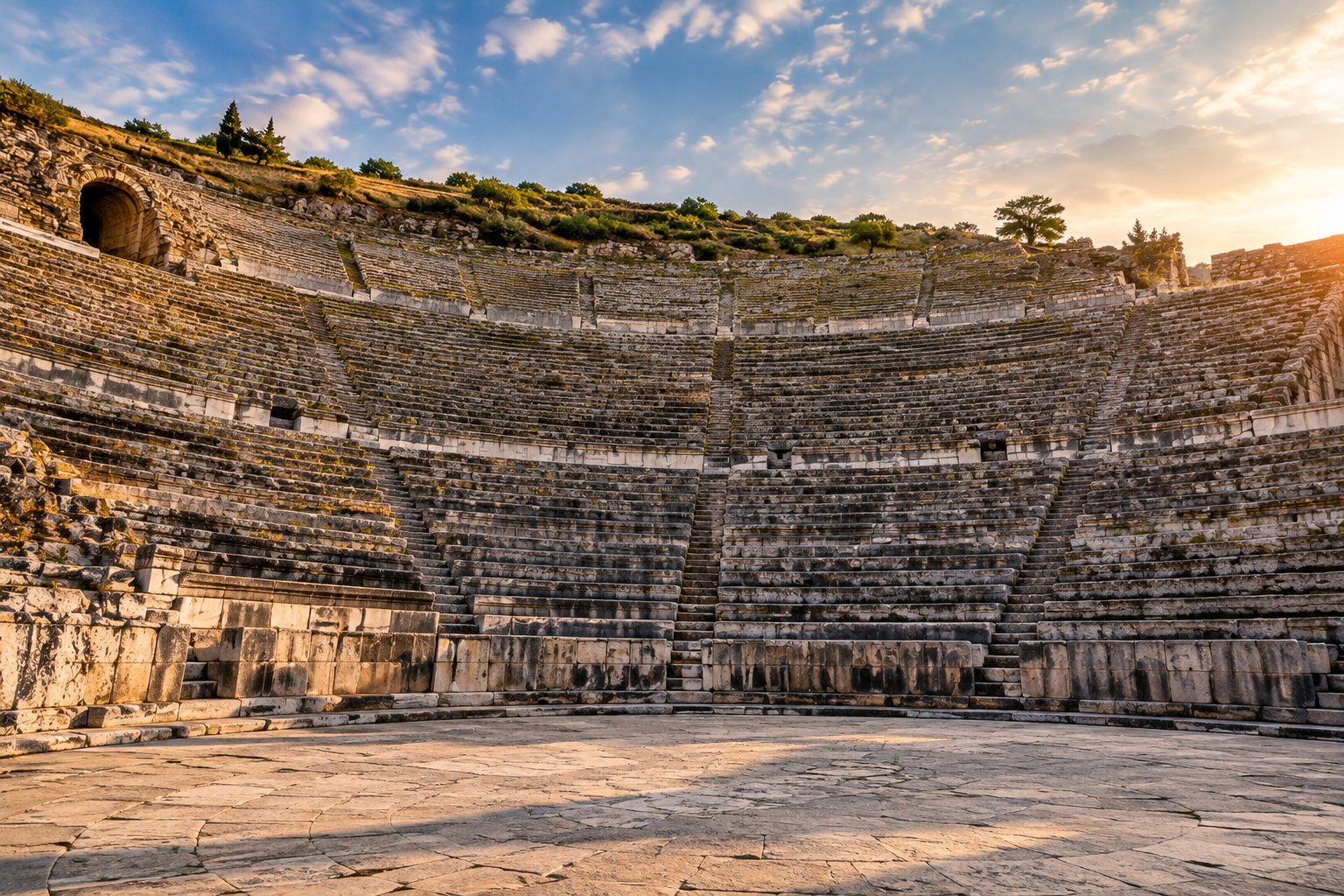
Further up the same street is the great theatre, cut into the slope of Mount Pion, seating something in the order of twenty-five thousand people.
Visitors climb a few rows, take a photograph of the marble street below, and move on. Very few are told what happened in that bowl.
Acts 19 tells it. A silversmith named Demetrius, who made shrines of Artemis, called together the men of his trade and told them plainly that this Paul was bad for business — and, he added, bad for the goddess. The city filled with confusion. Two of Paul’s companions were seized and dragged into the theatre. Paul wanted to go in; the disciples would not let him, and, the text notes almost in passing, some of the Asiarchs who were his friends sent word begging him not to risk it.
And then the detail that makes it real: for about two hours the crowd shouted the same sentence over and over.
Great is Artemis of the Ephesians.
Most of them, Acts says, did not know why they had come.
I have stood in that theatre in the early morning before the first coach, and the acoustics are still there. You can speak at a normal volume from the floor and be heard at the top. Twenty-five thousand voices in that space, for two hours, is not an abstraction once you have heard your own.
Paul stayed in this city a long time — three months arguing in the synagogue and two years in the lecture hall of a man called Tyrannus, by the account in Acts 19; looking back on it later he speaks of three years. Whatever the exact arithmetic, Ephesus was not a stop on his route. It was where he lived and worked longer than almost anywhere else.
A letter that may not have been written to Ephesus
Here is where I have to be careful, because this is the kind of thing a guide says confidently and a New Testament scholar winces at.
We call it the Letter to the Ephesians. But in the earliest and best manuscripts we have — including the oldest papyrus of Paul’s letters — the words in Ephesus are simply not there in the opening line. They appear later. Origen knew the text without them. Basil says explicitly that the older copies lacked them. And Marcion, in the second century, knew this letter under another name altogether: the letter to the Laodiceans.
The most common explanation is that it was a circular letter — written to be carried around the province of Asia and read in one assembly after another, with the name of each community filled in as it arrived.
I find that more moving rather than less, and I will tell you why it matters to me personally.
In the fourth chapter of Colossians, Paul asks that his letter be read in Laodicea, and that the community at Colossae read in turn “the letter from Laodicea.” Nobody knows with certainty which letter that was. Some have proposed that it is the one we call Ephesians.
My office is ten minutes from Laodicea. I drive past it on the way to work. If the circular-letter reading is right, then the text we hand to pilgrims at Ephesus was also heard, once, on the ground I park my car on.
I cannot prove that. Nobody can. But standing in one place while holding open the possibility that the same words were read aloud in another place two hours down the road is a different experience from reading a plaque.
The first of the seven
Ephesus opens the Book of Revelation’s seven letters. It is addressed first, in chapter two, and what it is told is not comfortable: you have worked, you have endured, you have not grown weary — and you have abandoned the love you had at first. Remember where you have fallen from. Otherwise the lampstand will be removed from its place.
I am aware that it is too easy, and probably wrong, to read that as a prophecy about the harbour. The text is speaking about a community, not a shipping channel.
But the image sits in the same landscape as the silt. A city that could not keep the sea, told that it could lose its place. You do not have to make a doctrine of it. You only have to stand there in the late afternoon and notice that the two are in the same frame.
John is traditionally associated with Ephesus, and the Basilica of St John — the great sixth-century church raised by Justinian over the site venerated as his tomb — stands a few minutes away in Selçuk. On the hillside above the ancient city is the house venerated as the Virgin Mary’s. Neither of these is a matter of archaeological certainty, and I would rather say so than pretend otherwise. They are places of memory, and memory is not a lesser thing.
A fortnight in 431
One more, and it is the one most often missed entirely.
In 431 the Council of Ephesus met in this city to settle what may be the most consequential single question of the early Church: in what sense the one born of Mary was God. The council affirmed the title Theotokos, God-bearer, and condemned Nestorius.
It was not a tidy meeting. Cyril of Alexandria opened proceedings before the bishops from Antioch had arrived; when they did arrive they held a rival council and condemned him in turn. The emperor, for a while, had both men under arrest.
What came out of it nevertheless shaped Christian doctrine east and west for the next sixteen centuries. Every Christmas carol that calls Mary the mother of God is downstream of a fortnight in this city.
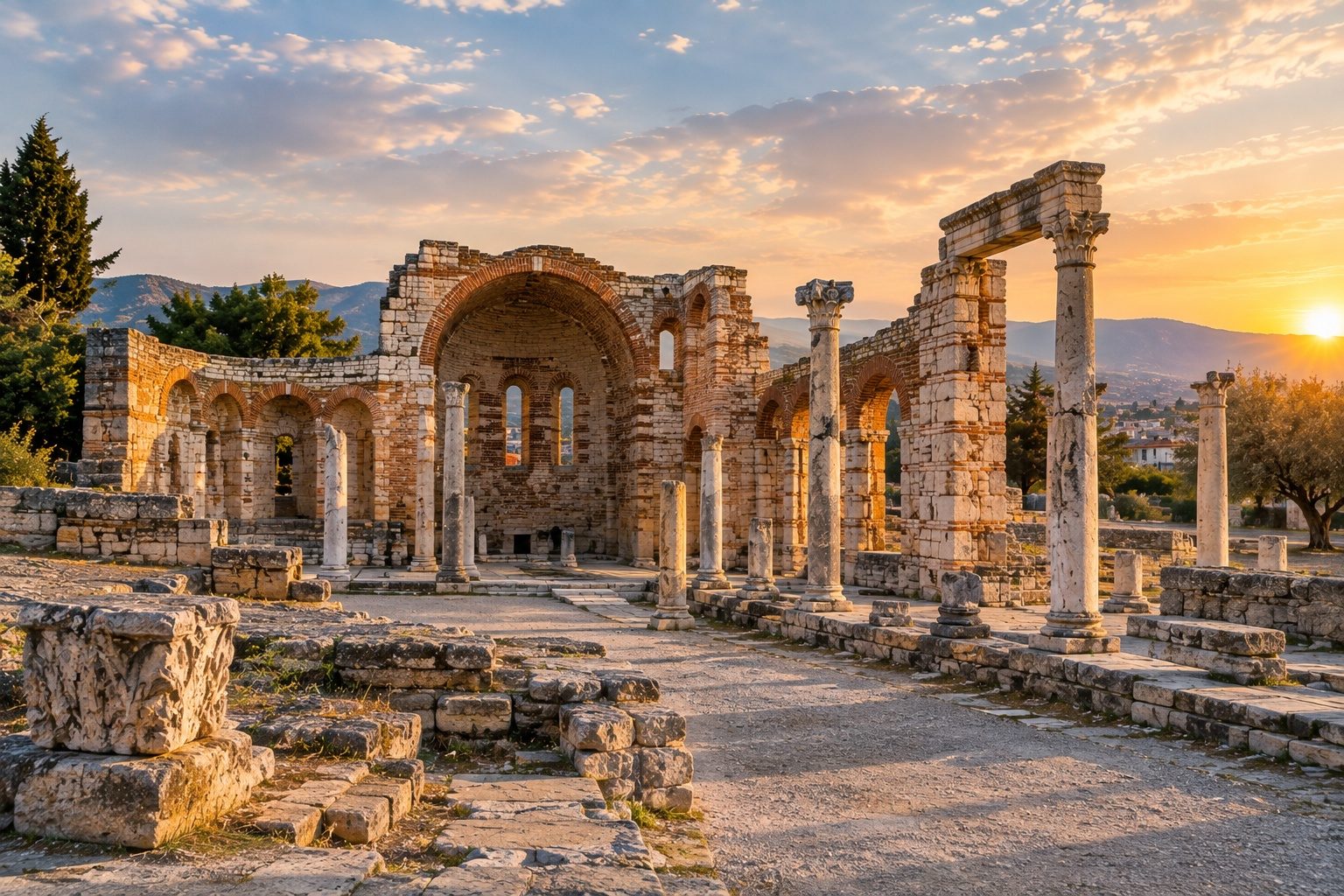
Groups walk through the site where this is traditionally located and are told nothing about it, because it takes four minutes to explain and the coach leaves at eleven.
A harbour that the city fought for and lost. A two-hour riot in a theatre you can still hear yourself in. A letter that may have been addressed to somewhere else, or to everywhere. A warning about a lampstand. A council that decided how half the world would speak about God.
All of it in a place most visitors cross in ninety minutes on the way to lunch.
I am not criticising anyone for the ninety minutes. Time is short and the list is long, and on a first visit the list is exactly right.
But if you have already been — to Ephesus, to Cappadocia, to any of it — then my question is not really where you would like to go next.
It is whether you would like to see the same places again, and this time be told what you were standing in.
Tell us where you have already been. We will show you what you missed.
Sources
The harbour. Strabo, Geography 14.1.24, for the mole of Attalus II and the engineer who warned against it. The Küçük Menderes (ancient Cayster) as the agent of silting, and the present distance of roughly six kilometres from the sea, are documented in the geoarchaeological work on the Ephesus harbour. Roman-period dredging and the attempt attributed to Hadrian to redirect the river are reported in the same body of work.
The riot. Acts 19:23–41. Demetrius and the silversmiths; the seizure of Gaius and Aristarchus; the Asiarchs’ warning to Paul; the crowd shouting for about two hours; the note that most of them did not know why they had assembled. Paul’s length of stay: Acts 19:8–10 (three months in the synagogue, two years in the hall of Tyrannus); Acts 20:31 (three years).
The address of Ephesians. The words ἐν Ἐφέσῳ are absent from Ephesians 1:1 in the earliest witnesses, including the third-century papyrus P46 and the original hands of Codex Sinaiticus and Codex Vaticanus. Origen and Basil of Caesarea both comment on copies lacking the phrase; Marcion knew the letter as addressed to the Laodiceans. The circular-letter hypothesis follows from this evidence and is widely, though not universally, held. Colossians 4:16 for “the letter from Laodicea.”
Revelation. Revelation 2:1–7, the letter to Ephesus. The connection drawn here between the lampstand and the harbour is my own reading and should be taken as that, not as an interpretation the text supports.
The Basilica of St John and the House of the Virgin Mary. The basilica at Selçuk is a sixth-century foundation of Justinian raised over the site venerated as the apostle’s tomb. The house on Bülbüldağı is a place of long-standing veneration and pilgrimage. Neither identification rests on decisive archaeological proof, and both are presented here as tradition.
The Council of Ephesus. Held in 431; affirmed the title Theotokos and condemned Nestorius. Cyril of Alexandria convened before the arrival of the Antiochene delegation, which subsequently held a counter-session; both Cyril and Nestorius were briefly detained on imperial orders. The standard conciliar histories cover the sequence in detail.