
By Zübeyir Kılınç, Ph.D., Director of Global Partnerships at Travione Global, based in Denizli, Türkiye.
There is a particular silence that falls over a group standing in front of a closed gate.
It is not anger. Anger would be easier. It is the sound of fourteen people recalculating a day they had already spent in their heads — the photograph they had planned, the thing they had told their family they would see, the two hours now sitting empty in the middle of a holiday that cost them a great deal.
Topkapı Palace is closed on Tuesdays. It says so plainly on its own visiting page. And yet somebody, somewhere in the world, is standing at that gate on a Tuesday this week, holding a printed itinerary that somebody else wrote.
Two directions
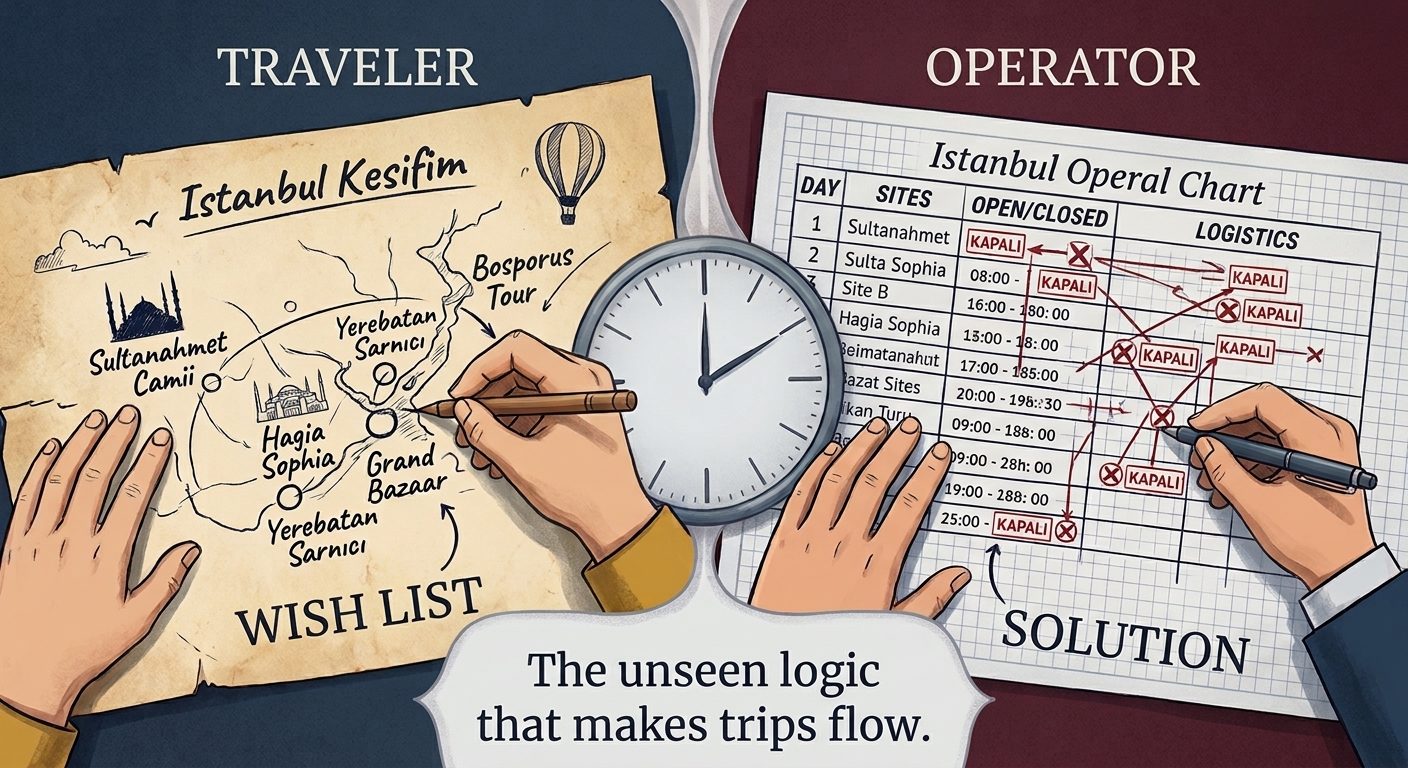
A traveller plans forwards. I want to see the palace, the great church, the cistern, the bazaar. Then: how many days do I need, and in what order.
An operator plans backwards. What is shut, on which day, and what does that force.
These two directions produce the same document and they are not the same craft. The first is a wish list with times attached. The second is the solution to a constraint problem, and the constraints are not published in one place, do not move together, and are not symmetrical.
Topkapı closes on a Tuesday. The National Palaces — Dolmabahçe, Beylerbeyi, Küçüksu, Ihlamur, Beykoz Mecidiye — close on a Monday. Those two facts alone, which contradict each other in the most inconvenient way possible, are enough to determine the shape of a three-day programme before anybody has expressed a preference about anything.
Add the rest and it compounds. Some sites run different winter and summer hours. Some close for a religious holiday whose date moves every year by eleven days. Some have a ticket office that shuts an hour before the site does, which is a different closing time wearing the same clothes.
There is no day on which everything is open
This is the part people find hard to believe, and it is the heart of the problem.
Istanbul does not have a weekly day off. It has several, staggered, belonging to different institutions that never coordinated with each other and had no reason to. The palaces answer to one authority, the museums to another, the mosques to a third, the markets to nobody at all.
So a four-day programme is not four days of choosing. It is four days of elimination, after which you choose from what is left. You put the palace on the day the palace is open, which decides what the afternoon can be, which decides where you sleep, which decides what the next morning can reach without an hour in traffic.
The order is not an aesthetic decision. By the time you have respected the closures, the order is mostly made for you, and the remaining art is in the thirty per cent you still control.
I should say plainly that I do not keep these days in my head, and I am suspicious of anybody who says they do. They change. A palace closes for restoration for eighteen months. A site is handed from one ministry to another and the day moves with it. The operator’s skill is not memory, it is the discipline of checking again for every single departure, including the one going to the place you sent a group to last month.
Everything I have not verified for a particular week, I treat as unknown. That sounds laborious. It is laborious. It is also the entire job.
Workshops are worse than monuments
Outside the museum world it gets harder, and this is where most itineraries quietly give up.
A monument has visiting hours. A workplace has a working week.
If a programme includes a village weaving workshop, a small factory, a cheese maker, a farm — the kind of stop people remember long after they have forgotten which emperor built what — then you are no longer reading opening times. You are asking a business to receive strangers on a day when it is trying to work, and to do it at a specific hour, three months from now, for a number of people that might change.
Most of them do not open at weekends, which is precisely when leisure groups are moving. Many will not commit to a date that far out. Some will say yes warmly and mean it, and then the season turns out differently and the thing they make is not being made that week.
So a programme with real workplaces in it is not a richer version of the monument programme. It is a structurally harder document, with more points of failure, and it has to be confirmed rather than assumed — by name, by telephone, with somebody’s word behind it.
The reason to build it anyway is that it is the only part of the trip the traveller could not have arranged alone.
What the visitor actually experiences
Here is what makes this strange work to be in.
When it is done properly, the visitor does not experience any of it. They experience a week that flowed. The bazaar happened to be open. The palace happened to be free of crowds. The afternoon they were tired happened to be the afternoon with nothing scheduled.
They will often describe this as taste. They really knew the city. Sometimes they describe it as luck.
It was arithmetic, done weeks earlier by somebody they never met, and the highest compliment the work can receive is that it was invisible.
When it is done badly, the visitor experiences all of it at once, standing at a gate on a Tuesday.
That asymmetry is unfair and it is also the correct one. The closed gate is the only version of this labour that is ever visible, which means the entire discipline is only ever noticed in the moment it has failed.
The part that does not show
I have never seen a quotation that lists this.
Hotel, guide, vehicle, entrance fees, meals — those are the lines, and they are the same lines for every operator selling the same city. The thing I have described does not appear on any of them. It has no unit, no rate, and no way of being compared between two proposals sitting side by side on a desk.
A client choosing between two quotations cannot see the difference between an operator who checked and one who copied last year’s file.
They will see it on the Tuesday.
I do not have a solution to that, and I am wary of essays that end by proposing one. What I would say to anyone buying ground services, in this country or any other, is that the question worth asking is not what is included. It is a duller question, and it tells you far more.
When did you last confirm this itinerary, and against what?
The answer takes ten seconds and you will learn everything you need to know.
Sources
Topkapı Palace. The palace’s visiting information states that the museum is closed on Tuesdays, with hours given as Monday to Sunday, Tuesday excepted.
National Palaces. Visiting days published by the Istanbul Chamber of Tourist Guides list Dolmabahçe Palace, Beylerbeyi Palace, Küçüksu Pavilion, Ihlamur Pavilion, Beykoz Mecidiye Pavilion and the Painting Museum as closed on Mondays.
On what is deliberately absent here. I have named only the closures I was able to confirm against a published source at the time of writing. Several sites commonly listed in guidance of this kind — Yıldız, the covered markets, and others — I could not verify to my own satisfaction, and I have left them out rather than repeat them from memory. That is not modesty. It is the same rule the essay argues for: a closing day you have not checked this season is not a fact, it is a recollection, and recollections are what put groups in front of locked gates. Opening days and hours change; anything here should be confirmed against the site’s own information before it is used to plan anything.