
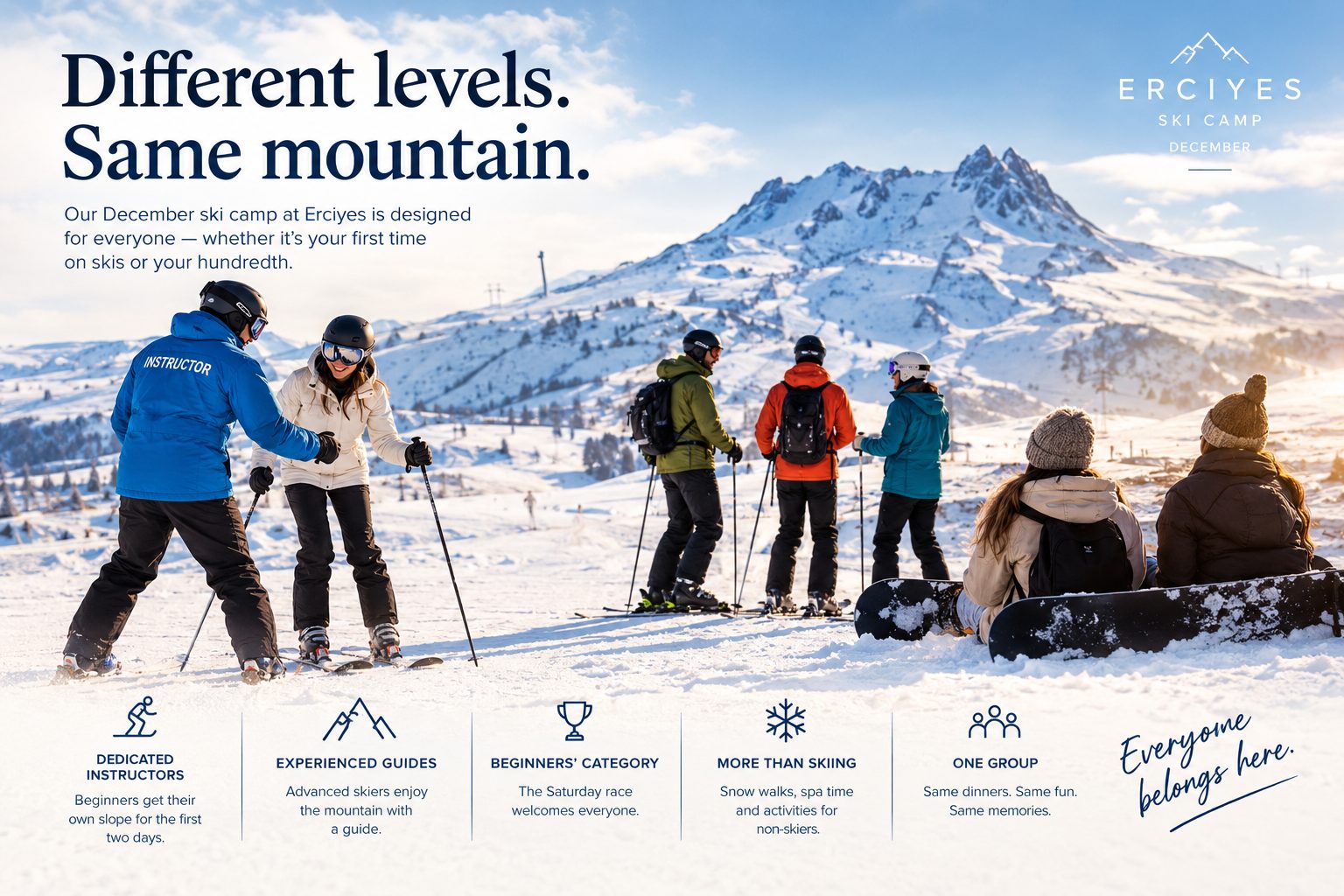
Half the people coming on our December ski camp have never been on skis.
I did not expect that. A ski trip, you assume, is sold to people who ski. What came back instead, once the enquiries started, was a different question arriving again and again — usually late in the conversation, usually with a small apology attached to it.
I have never done this. Can I still come?
Nobody asked that about the price.
What the brochure quietly assumes
Our industry sorts travellers two ways: by where they want to go and by what they can afford. Destination and budget. Every filter on every booking site is one or the other.
Almost nothing sorts by competence, and yet competence is doing a great deal of hidden work. A ski week assumes you ski. A trekking itinerary assumes a pace. A diving trip assumes a certification and, underneath it, assumes you are comfortable in water. The brochure sells a place and silently requires a skill, and it requires it without ever saying so, which is the part that does the damage.
Because a person who cannot afford a trip knows they cannot afford it. They decline and move on. A person who can afford it but suspects they will be the worst one there does something quieter. They say they are busy that week.
That is a lost sale which never appears as a lost sale. It leaves no trace in any system we keep.
Where a mixed group actually breaks
I want to be precise about this, because “we welcome all levels” is a sentence every operator writes and very few design for.
A mixed-ability group does not fail on the first morning. It fails at about four in the afternoon on the second day, and then it fails again at dinner.
What happens is this. The confident skiers spend the morning waiting. By lunch they have decided, politely and without saying it aloud, to go off on their own after the break — which is reasonable, and which is also the moment the group stops being one group. The beginners, who have spent the same morning being watched, now have confirmation of the thing they already feared: they are the reason everyone else is standing around in the cold.
By the evening there are two tables. One is telling stories about the red run. The other is talking about something else entirely, slightly too brightly.
Nobody complains. The feedback form comes back fine. And neither table books again.
What we changed
Our answer is not clever. It is only deliberate, and most of it is schedule rather than service.
For the first two days the beginners are on a separate slope with their own instructor — not at the back of the main group, which is the usual compromise and the worst one. The experienced skiers get a guide and the mountain, which is what they came for. The two groups are not managed into the same space until both of them want to be there.
The Saturday race has a beginners’ category. This sounds like a small thing. It is the single most important line in the programme, because it is the moment the trip stops being the skiers and the others and becomes one event with two classes in it, the way every real competition is organised.
There is a snow walk and a spa block for people who have no intention of skiing at all and came because their partner did. We stopped treating those people as an afterthought when we noticed how many enquiries included one.
And the evenings are built to be the same for everybody. Dinner, a race, a prize, an argument about who deserved it. The mountain divides people by ability. The evening has to put them back together, and it will not do that on its own.
Why none of this is in the price
Look at what a ski package is made of and you will find the cost sitting almost entirely in things you can buy: the hotel, the skipass, the equipment, the coach, the insurance. Those are the lines on the invoice, and they are more or less the same lines for every operator selling the same mountain.
The thing I have just described is not on that list. Putting the beginners on their own slope for two days costs an instructor and costs the convenience of running one group instead of two. Adding a category to the race costs nothing at all. Neither appears as a product feature, and a client comparing two quotations will not see the difference between an operator who has thought about this and one who has not.
They will see it on the second afternoon.
This is a familiar shape to me. In an earlier piece I argued that what we actually sell into an unstable currency is not a price but certainty. This is the same argument in a different coat: what we are selling to the person who has never skied is not a lesson. It is permission to be bad at something in front of thirty people they know, and to still have a good evening.
Nobody has worked out how to put that on a rate sheet.
About the mountain, briefly
Since the question comes up from abroad: Erciyes has 41 pistes and 112 kilometres of them. The pistes run between roughly 2,088 and 3,346 metres, with the Ottoman piste — the highest in Türkiye — at 3,400. The volcano above them reaches 3,917.
The figure that matters for a December departure is a duller one. There are 154 snow machines, and about three quarters of the pistes are covered by artificial snow. Mid-December in Türkiye is not a season you can take on trust at every resort, and the honest way to sell a winter programme is to know which mountains do not need you to.
What I do not know yet
The camp has not run. It leaves on 17 December.
So everything above is a design, not a result. I believe the two-table failure is real because I have watched it happen on other people’s trips and on some of our own; I believe the fixes work because they are small and specific and address the actual moment things go wrong. But I have not yet stood in that dining room on the Saturday night and watched whether it holds.
I will write the other half of this in January, including the part where it did not work.
What I am more confident about is the thing that started it. Half our group has never skied, and they were not waiting for a discount. They were waiting for somebody to say, in writing, that the trip had been built with them in it.
That sentence is free. We should all write it more often.
Sources
Erciyes ski resort. Piste count and total length — 41 pistes, 112 kilometres — as reported by TRT Haber, citing Erciyes AŞ; the same figures appear in current destination guides. Piste elevations of approximately 2,088 to 3,346 metres and the Ottoman piste at 3,400 metres, described by TRT as the highest piste in Türkiye. Mount Erciyes summit elevation 3,917 metres. Snowmaking: 154 machines, with artificial snow covering roughly three quarters of the pistes.
A note on the 112-kilometre figure. It originates in a December 2021 statement by the chairman of Erciyes AŞ and is still the figure quoted in 2026 guides. I have not found a more recent official measurement, and I would not want it read as a 2026 audited number. No source I could find describes Erciyes as the largest ski area in Türkiye by piste length, and I have deliberately not made that claim.
On the limits of this reading. The programme described here departs on 17 December 2026 and has not yet taken place. The failure mode I describe — a mixed-ability group separating by the second afternoon and not reassembling — is drawn from observation rather than from any dataset, and the remedies are untested at the time of writing. This is an argument about design, offered before the result is known rather than after, which is the only honest way to publish it in October.