
Our winter calendar started in January. That was the plan, and the plan was reasonable: Istanbul in deep winter, small groups, a season nobody fights us for.
Then the enquiries began arriving for November.
Not a trickle. Enough of them, close enough together, asking for the same month, that the question stopped being whether we had a November product and became why we did not. So we opened one — a single departure, four days, late November, at a price we would not run all winter.
There is an old argument about whether supply creates demand or demand creates supply. I have never found it very interesting in the abstract. It becomes interesting when you are the supply, and a WhatsApp inbox is telling you that you have published the wrong calendar.
What I did not expect was what happened next.
The demand was not one market
The enquiries looked homogeneous. Almost all came from the Gulf — Saudi Arabia, Kuwait, Qatar, the Emirates, Oman. Same region, same cities, frequently the same districts of the same cities. Family travel, four days, winter, two adults and sometimes children.
Within two weeks it became clear they were two entirely different markets.
One group could travel in November. The other could not travel before January, and in several cases did not know it yet.
The line between them had nothing to do with budget, with how far ahead they were planning, or with how much they wanted to come. It was not even, quite, their nationality.
It was their residence permit.
How the rule actually works
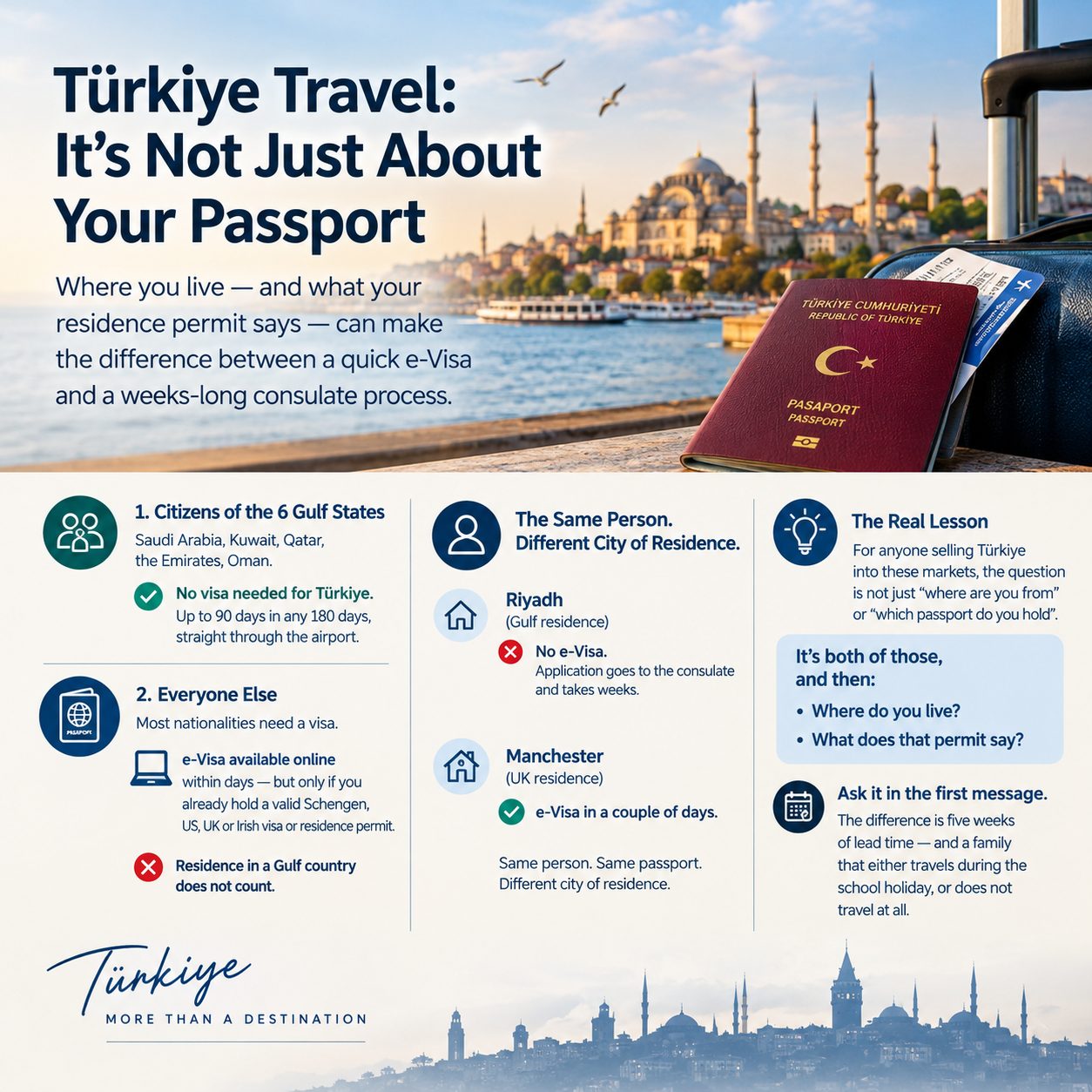
Citizens of the six Gulf states need no visa for Türkiye. Ninety days in any one hundred and eighty, straight through the airport, nothing to arrange.
Everybody else needs one. For a long list of nationalities an electronic visa is available, granted online in a matter of days — but only on a condition. The traveller must already hold a valid Schengen, United States, United Kingdom or Irish visa, or a residence permit from one of those.
Residence in a Gulf country is not on that list.
So consider two men with the same Indian passport. One has lived in Riyadh for twelve years. He pays tax there, his children are in school there, his life is there in every sense a person’s life is anywhere. He cannot use the e-Visa. His application goes to a consulate and takes weeks.
The second lives in Manchester. His e-Visa is issued in a couple of days.
Same document. Different city. Five weeks of difference in when a family can get on a plane — which, for a trip built around a school holiday, is frequently the difference between travelling and not travelling.
The language of the enquiry predicted the answer
The part I found most useful was accidental, and it came from how the enquiries arrived.
Messages that came in Arabic were, with very few exceptions, from Gulf nationals. Visa-free. They could take the November departure, and some of them are going to.
Messages that came in English were mostly from the expatriate workforce — Indian, Pakistani, Bangladeshi and Filipino passports held by people resident in the Gulf. Almost none of them qualified for the e-Visa. Almost all of them had to be moved to January or February.
I had not designed that as a filter and I would not have thought to. But our advertising runs in Arabic, and the language of a campaign turns out to select, fairly precisely, for the visa status of the person who answers it.
In two weeks I moved seven enquiries from the November departure to the new year for this reason alone. Not one of them had raised it. Every one of them had assumed that because they lived in the Gulf, they travelled the way their Gulf-national neighbours travel.
I should be careful here, because this is the point at which a confident sentence would be dishonest. This is two weeks of one company’s WhatsApp traffic in one season, in a single destination, through a single advertising channel. It is a pattern, not a finding, and I would not defend it as more than that. A different budget, a different creative, a different month might sort the same market differently.
What I will defend is the mechanism, because the mechanism is written down in the regulation and does not depend on my sample.
What it costs, and who pays it
The cost of getting this wrong does not land on the operator first. It lands on the traveller.
A family decides in October to travel in late November. They have the money, the dates and the will. Nobody asks them about their residence permit, because the question sounds impertinent and because most people in this trade ask “where are you from”, which is the wrong question twice over. They book flights. They start a consulate application in the second week of November. It does not come back in time.
And then the operator who sold them the trip has a conversation that no amount of good service repairs.
The avoidable version of this takes one sentence, asked in the first message, before anything is priced: what nationality is written in your passport, and where do you hold residence?
It feels intrusive the first time you send it. It stops feeling intrusive the first time it saves someone a thousand dollars.
What this changes on our side
Three things, and none of them are clever.
The first is that the question moved to the top. Not into the booking form, not into the confirmation stage — into the first reply, before dates and before price. A quotation built on a departure the client cannot legally reach is not a quotation.
The second is that we stopped treating “the Gulf” as a market. It is at least two, and the division runs through households rather than between countries. The same residential tower in Doha contains both.
The third is harder to write down. When a client turns out to be on the slow side of that line, the useful thing is not to apologise for a rule we did not write. It is to move the conversation to a month that works and say plainly why. Nobody has ever been annoyed with me for explaining a regulation. Several people have been annoyed, rightly, with an industry that let them find out at the consulate.
The part I keep coming back to
We opened the November departure because the demand told us to. That was the right call and I would make it again.
But demand is not a quantity. It arrives already sorted by things that have nothing to do with wanting to come — by a line in a regulation, by which embassy issued a plastic card, by the accident of which city a person took a job in eleven years ago.
Our job in the middle is not only to count the demand. It is to know which half of it can actually get on the plane, and to say so first.
Sources
Visa regime, Türkiye. Republic of Türkiye Ministry of Foreign Affairs, Visa Information for Foreigners. Citizens of Saudi Arabia, the United Arab Emirates, Kuwait, Qatar, Bahrain and Oman are exempt from visas for stays up to 90 days within any 180-day period. Ordinary passport holders of the United Kingdom and of Ireland are likewise exempt for up to 90 days in any 180-day period. For nationalities subject to the conditional e-Visa, eligibility requires a valid Schengen, United States, United Kingdom or Irish visa or residence permit; residence in a Gulf state does not satisfy this condition.
On the limits of this reading. The correlation described here between the language of an enquiry and the visa status of the enquirer is drawn from approximately two weeks of inbound WhatsApp traffic to a single operator, generated by advertising in a single language, for a single destination and season. It is offered as a working observation and a prompt to ask a better question at first contact. It is not a market study, and I would not want it cited as one.