
By Zübeyir Kılınç, Ph.D., Director of Global Partnerships at Travione Global, based in Denizli, Türkiye.
On the shortest day of the year, Istanbul gives you nine hours and thirteen minutes of daylight. By late January the sun is still not up at half past eight in the morning. Everything else about a winter visit follows from that one number, and almost nobody plans for it.
I say this as someone who sells the city. The honest version of the winter sales pitch is not that Istanbul is warm in January — it is not — but that the city is finally quiet enough to be seen. Whether that trade is worth making depends entirely on what you came for.
What the weather actually does
Between December and February daytime temperatures in Istanbul sit at roughly four to eleven degrees Celsius. December is the wettest month of the winter, with around seventy millimetres of rain spread over nine or ten days. February is the coldest and the windiest. Snow falls most years, usually in February, and usually not much: an average of a few centimetres across the season, occasionally far more.
None of those figures describe the thing people remember. What they remember is the wind. Istanbul sits between two weather systems and the winter belongs to them: the poyraz comes down cold from the northeast, and the lodos comes up warm and heavy from the southwest. The lodos is the one that rearranges your day. It pushes the sea against the Bosphorus shore, and when it blows hard the ferries stop. Not some of them — the crossings close, and a city that moves on water has to move by road instead.
A guest who has flown in from the Gulf and booked a Bosphorus cruise on a Tuesday afternoon will not care that the suspension is a maritime safety decision. So we do not promise a particular afternoon for the water. We promise the water, and we keep two days open for it.
Short days are a scheduling problem, not a weather problem
Nine hours of light is enough for Istanbul if the nine hours are spent well. It is not enough for the itinerary most visitors imagine.
Topkapı, Hagia Sophia and the Blue Mosque sit within a few hundred metres of each other, and a certain kind of travel writing suggests you can do them in a morning. You can walk past them in a morning. Topkapı alone, taken seriously — the Harem, the treasury, the courtyards, the view over the water where two seas meet — is most of a day. In summer you can start late and finish at seven. In January the light is gone by half past five.
So winter itineraries in Istanbul are built backwards from the dark. The big interior sites go in the morning, when the light through the windows of Hagia Sophia is doing what it was designed to do. The afternoon is for the covered things: the bazaars, the cisterns, a long lunch, a hammam. And the evening, which in winter starts absurdly early, is for the part of the city that was always meant to be seen lit — the Golden Horn from a hill, the ferry lights crossing between continents.
The closing days decide the order
This is the part of the work that no guest ever sees and that ruins more Istanbul trips than the weather.
The major sites close on different days of the week, and they do not coordinate. Under the National Palaces regulations, Topkapı closes on Tuesdays, Yıldız Palace on Wednesdays, and every other palace, pavilion and museum in their care — Dolmabahçe among them — on Mondays. The Grand Bazaar and most of the covered markets close on Sundays. A four-day programme that begins on the wrong weekday cannot include everything, no matter how early you get up or how much you pay.
Work it through and the shape of the week appears on its own. A Monday start loses Dolmabahçe on day one and must push it to the end. A Tuesday start cannot open with Topkapı, which is the one site everybody wants first and the one that needs the most daylight. A Sunday in the middle is a day with no bazaar in it. None of this is difficult; it simply has to be done before anything else, and it has to be done again whenever a date moves.
There is no cleverness in solving it. You take the closing days, you take the arrival day, and you arrange the rest around them before writing a single line of the itinerary. It is the first thing we do, and it is why our İstanbul programmes do not all run in the same order. A departure beginning on a Monday is not the same programme as one beginning on a Thursday, even when the list of places is identical.
I mention it because it is a fair question to ask anyone selling you a city: in what order, and why that order?
What the quiet is worth
Here is the case for winter, and I will put it plainly.
In the high season, the inner courtyard of Topkapı is a queue. The Basilica Cistern is a slow-moving line of shoulders. The terrace above the Golden Horn is a competition for a photograph. In January, on a cold Tuesday with rain in the air, those same places are nearly empty, and the city stops performing for you.
A mosque with forty people in it is a building. A mosque with four is a room where something happens. The difference is not aesthetic — it is the difference between looking at a place and being somewhere.
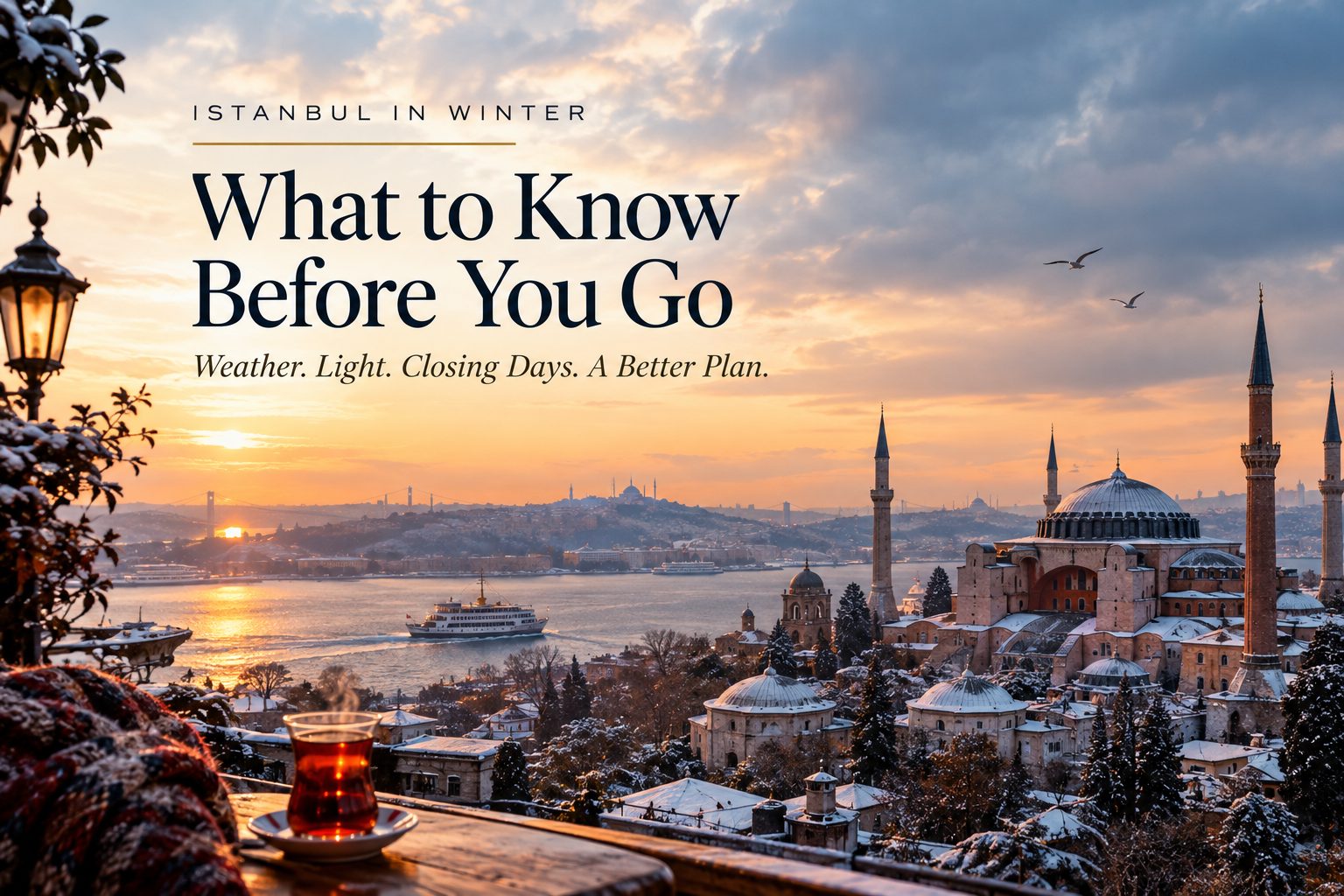
The same is true of the ordinary city. Winter is when Istanbul eats properly: the fish is at its best, the boza sellers are out at night, roasted chestnuts and kumpir and the heavy winter soups appear on streets that sell ice cream in August. A tea at a window with the rain on the Bosphorus outside is not a consolation prize for bad weather. For a great many of our guests it turns out to be the thing they describe first when they get home.
Who should not come in winter
I would rather lose a booking than place someone in the wrong season, so: do not come in winter if your trip depends on sitting outside, on a swim, on a boat day in the Princes’ Islands, or on photographs taken in long golden evening light. Do not come in winter if nine hours of daylight and a real chance of rain on three days out of your four would spoil it. Come in April or May, or in September. The city is a different proposition then and we will say so.
Come in winter if you want to stand inside the buildings rather than queue outside them, if a cold wind is an acceptable price for an empty courtyard, and if you would rather eat well than sunbathe.
What we do about it
Three practical things, and they are the whole of our winter method.
We order the days around the closing days and the light, not around what looks neat on paper. Interiors in the morning, covered ground in the afternoon.
We keep the water flexible. The Bosphorus stays in the programme but not nailed to one afternoon, because the lodos does not take bookings.
We plan for rain rather than hope against it. Every winter day has an indoor alternative already chosen — not improvised at breakfast when the sky turns. A wet afternoon in Istanbul is one of the better afternoons available anywhere, if somebody has thought about it in advance.
That is less romantic than it might be. But the romance of the city in winter is real and it does not need help from me; what it needs is for somebody to have checked which day Dolmabahçe is shut.
Practical notes
Daylight. Around nine hours on 21 December; sunrise close to 08.30 in late January. Plan interiors for the morning.
Temperature. Roughly 4–11 °C by day through December, January and February. February is the coldest and windiest month.
Rain. December is the wettest winter month — about 70 mm over nine or ten days. Bring a coat that handles wind rather than an umbrella; the wind takes umbrellas.
Snow. Likely at some point, usually February, usually light. Heavy snow happens and closes things when it does.
Ferries. Strong lodos can suspend Bosphorus crossings at short notice. Keep the water day movable.
Closing days. Topkapı closes on Tuesdays, Yıldız Palace on Wednesdays, and the other palaces and pavilions — including Dolmabahçe — on Mondays. The Grand Bazaar and the covered markets close on Sundays. Fix the order of your days around these before anything else.
References
Climate figures. Monthly averages for temperature, rainfall, snowfall, daylight and wind for İstanbul, drawn from the WeatherSpark climatological summary for the city (based on the MERRA-2 reanalysis): https://weatherspark.com/y/95434/Average-Weather-in-%C4%B0stanbul-Turkey-Year-Round
Winter winds. Poyraz (northeast) and lodos (southwest) are the two prevailing winter winds of the Marmara basin; northerly winds predominate through the season. Ferry suspensions during strong lodos are announced by the operators on the day.
Opening and closing days. The closing days given here follow Article 6 of the Directorate of National Palaces’ visiting regulations (Milli Saraylar Ziyaret Usul ve Esasları, in force 15 May 2026): Topkapı Palace closes on Tuesdays, Yıldız Palace on Wednesdays, and all other palaces, pavilions and museums in the Directorate’s care on Mondays. Dolmabahçe opens on 10 November even when that falls on a Monday. Ministry of Culture and Tourism sites are published at muze.gov.tr. Schedules change, and we confirm them for each departure rather than relying on a printed list.