
By Zübeyir Kılınç, Ph.D., Director of Global Partnerships at Travione Global, based in Denizli, Türkiye.
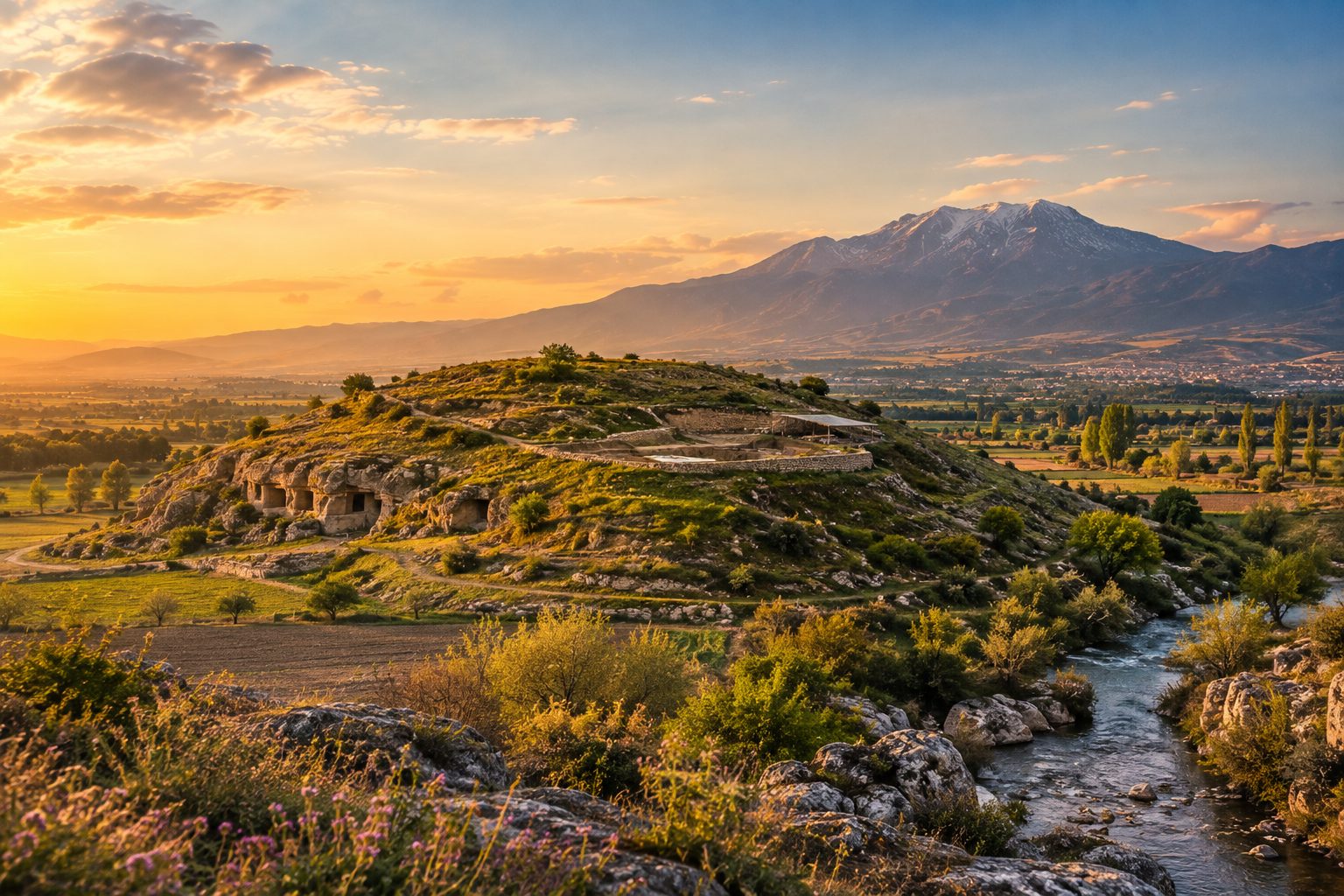
There is a hill about twenty-five kilometres east of this office, two or three kilometres north of the town of Honaz, and if you drive past it you will not look twice. It is a mound in a field, with the mountain behind it and a brown road sign in front of it. Sheep on it, some years. No columns, no arch, no theatre you could photograph. The guidebooks that mention it at all mention it in a sentence.
It is Colossae, and a letter written to the people who lived on it has been read aloud, every week, in churches on six continents, for nineteen hundred years.
That gap — between how much the text is read and how little the place is known — is the most interesting thing in this valley, and it has just started to close.
What is actually there
I want to be honest about this before anything else, because our industry is not always honest about it.
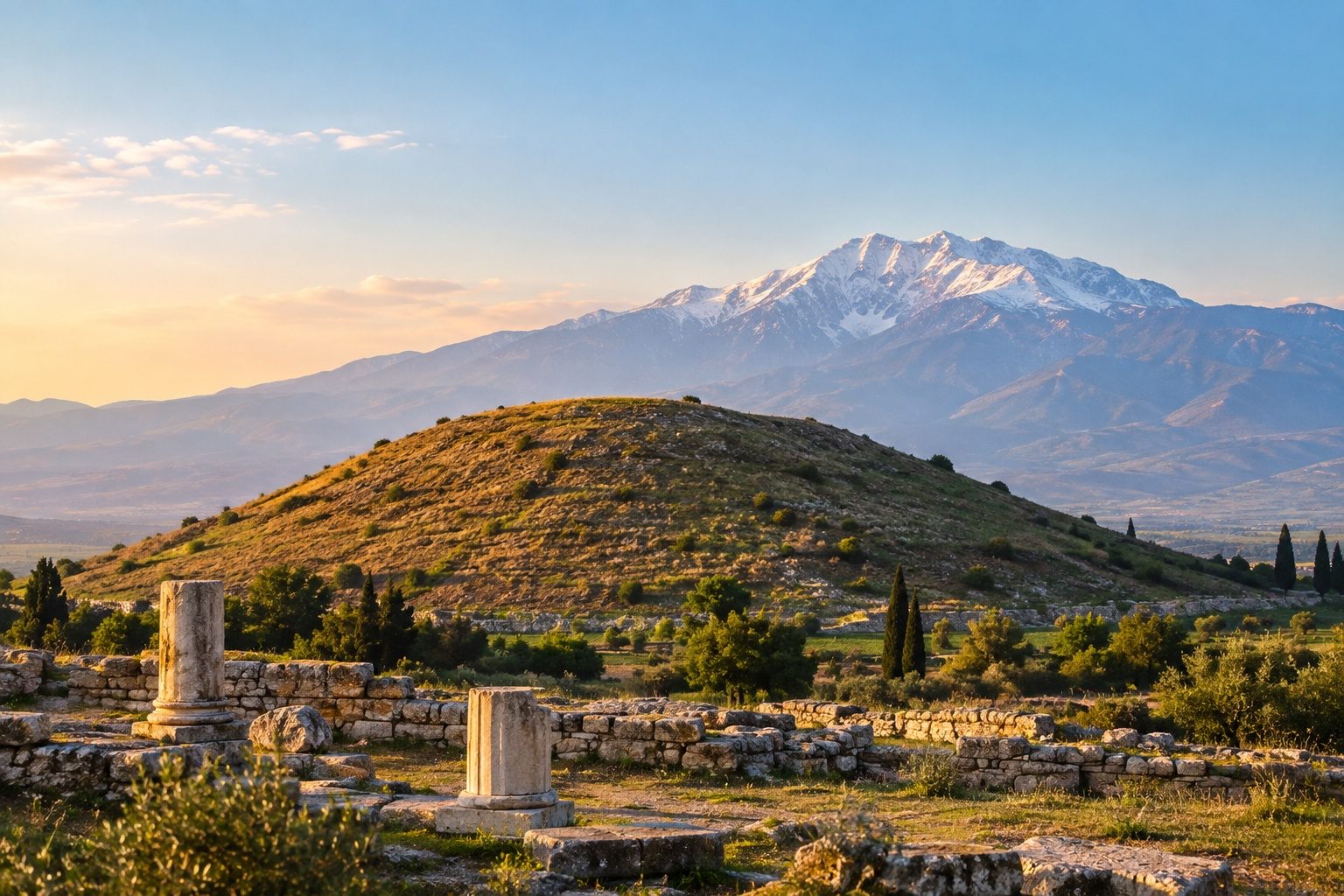
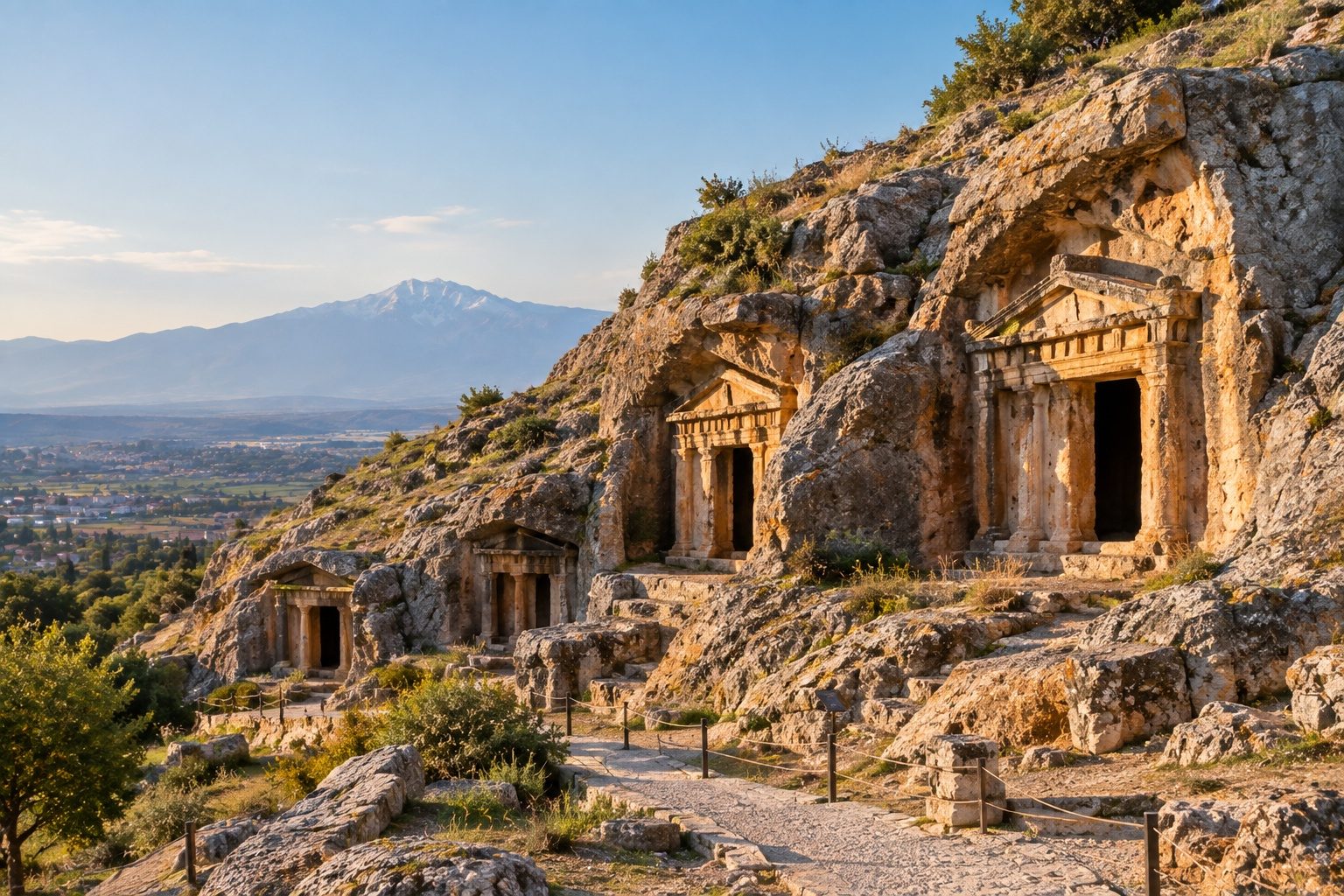
There is nothing to see at Colossae in the way that people mean when they say there is something to see. The Ministry of Culture’s own page says it plainly: there are no ruins of the ancient city. What there is, is a höyük — a tell, an artificial hill made of the city itself, layer on layer of mudbrick and floor and rubbish and rebuilding, piled up over millennia until the settlement was standing on its own past. It is perhaps thirty metres high. On the eastern slope there is a dip in the ground shaped like a bowl, and that is where the theatre was. Cut into rock nearby are tombs.
Everything else is underneath.
This is precisely why nobody dug it. Archaeology, like tourism, follows the visible. Fifteen kilometres up the valley is Laodicea, with a main street you can walk and a stadium and two theatres, and twenty kilometres beyond that is Hierapolis with its necropolis and its white terraces. When you have those two in one valley, the quiet mound with no marble on it waits. And it waited a very long time.
The letter
Paul wrote to this place, and on the usual reading he had never been there.
The church at Colossae was founded by a man named Epaphras, who was one of them — a local. Paul calls him that twice, in the first chapter and again in the fourth. When Paul speaks of the Colossians’ faith he says he heard of it. And in the second chapter he writes of his struggle for them, and for the people at Laodicea, and for “all who have not seen my face in the flesh.”
I should say that the grammar of that last verse is genuinely argued over. It can be read as meaning the Colossians and the Laodiceans, who are among those who have not seen me — which is how most scholars take it — or as the Colossians, the Laodiceans, and also everyone else who has not seen me, which leaves the question open. A minority have pointed out that Paul went through Phrygia more than once, and that the road through this valley was the obvious road. I am a guide and a ground operator, not a New Testament scholar, and I would rather flag the argument than settle it for you.
But take the ordinary reading for a moment, because it is remarkable. One of the most quoted letters in the New Testament — the one with the hymn about the image of the invisible God, the one that tells slaves and masters and husbands and wives how to live with each other — was written to a congregation the author had never met, in a town he had never seen, on the strength of a report from a friend.
And it was written to be passed on. At the end of it Paul instructs them: when you have read this, send it to Laodicea, and get the letter that is coming to you from there. Two churches fifteen kilometres apart, swapping post. That is the earliest publishing network in Christianity and it ran through this valley.
Three things everybody says that are not true
Because so little was known, the vacuum filled with repetition. Three claims follow Colossae everywhere, and all three collapse when you check them.
That an earthquake destroyed it in the year 60. Tacitus does report a great earthquake in Asia around then, and the city he names is Laodicea — which, he adds with some admiration, rebuilt itself without asking Rome for a lira. He does not mention Colossae. The text that names Colossae is Orosius, writing roughly three and a half centuries later, who lists three cities falling together. He may be right. He may also simply be generalising Tacitus across the valley, which is the sort of thing late compilers do.
That it was abandoned afterwards. It was not. Colossae went on minting its own coins into the third century, and its bishops were still signing conciliar documents four hundred years after that. Whatever happened in the year 60, the town got up again.
That it was famous for purple wool. This one is the most persistent and the most wrong. A colour genuinely was named after the city — colossinus — and Strabo confirms the Colossians made money from it. But Strabo does not say what colour it was. The only ancient writer who tells us is Pliny, who uses colossinus to describe the flower of the cyclamen. So: a pinkish mauve, the colour of the small wild flowers that come up on these hillsides in spring. The deep black wool belongs to Laodicea, from the same passage of Strabo. The purple belongs to Tyre, and to Lydia the dealer in purple cloth from Thyatira. Three different cities, three different colours, endlessly merged into one sentence in tour brochures.
The real decline of Colossae is a duller story than an earthquake and a better one. It began centuries earlier, when Laodicea was founded down the road and the trunk road and the money moved with it. Herodotus, in the fifth century before Christ, called Colossae a great city of Phrygia. By the time Strabo wrote, around the time Jesus was a young man, it appears in a list of the small towns. It did not fall. It was overtaken.
2025
And then, last year, after nineteen centuries in which no archaeologist had put a trowel into it, somebody did.
The excavation is directed by Dr. Barış Yener of Pamukkale University — our own university, here in Denizli — following a survey he ran from 2021. Colossae was given formal excavation status by presidential decree in 2025, and the first season opened that year.
The first place they went was the northern cemetery, and what came out was a field of about sixty rock-cut tombs, some two thousand two hundred years old. Bathtub-shaped graves cut straight into the travertine. Skeletons still in them. Little glass and clay bottles for oil and perfume, lamps, coins, sandals. Amulets. Inscribed stones that people had carried for protection or healing.
There is one detail from that season I have not been able to stop thinking about. Yener has pointed out that the cemetery is on the rock outcrop — the hard, useless ground — and that this was almost certainly deliberate. They put their dead where nothing would grow, so that the good soil could stay in cultivation.
That is not a fact about religion. It is a fact about people who farmed this valley and could not afford to waste a field, and who were still thinking about the harvest while they were burying their parents. There is more of the texture of ordinary life in that one decision than in a hundred column capitals.
The river that goes underground
One more thing about this place, and it is the strangest.
Herodotus, describing Xerxes’ army passing through in 481 BC, writes that at Colossae the river disappears into an opening in the earth, and comes up again about five furlongs further on. This is karst country; the water goes down through the limestone and comes back. It still does.
Centuries later a story grew up here about the Archangel Michael. In it, a shrine with a healing spring stands near Colossae, tended by a man called Archippus. Local pagans try to destroy it by diverting two rivers onto it. Michael comes down, halts the water, and splits the rock open so that the flood pours away underground.
The story is an explanation. Somebody looked at a river vanishing into the ground — the thing Herodotus had already written down eight hundred years earlier — and gave it a reason. And the name stuck to the place: Chonai, from the Greek for a funnel, for something poured away. Which is where the modern town of Honaz gets its name, and Honaz is the town whose lights you can see from the mound.
The name of the man tending the shrine in the legend, Archippus, is lifted straight out of the last chapter of Colossians, where Paul sends him a message: see that you fulfil the ministry you have received. Somebody, some centuries later, took a name from the end of a letter and gave it to the caretaker of a shrine, in a story invented to explain a hole in the ground that a Greek historian had noticed before the letter was ever written.
There are places where the layers are in the soil. Here they are in the names.
What it is worth
I take people to Laodicea, where there is a great deal to look at. I do not often take them to Colossae, because for years the honest answer to “what will we see” was: a hill.
That answer is changing, and not slowly. There is a trench open on that hill now and a team from the university down the road working it about half the year. Everything that was said about Colossae for nineteen centuries was said on the basis of a letter, a handful of coins, three lines in Strabo and a great deal of guessing. For the first time, there is going to be evidence.
I do not know what will come out of it. Nobody does — that is the point of digging. But I know that the next decade is the interesting one, and that it is happening twenty-five kilometres from where I park my car.
The letter has been read for nineteen hundred years. The city is only now being read.
Sources
The excavation. Colossae was surveyed by Dr. Barış Yener of Pamukkale University from 2021, and granted formal excavation status by presidential decree in 2025, with the first season that year. The northern necropolis produced approximately sixty rock-cut tombs of roughly 2,200 years’ age, with skeletal remains in situ, unguentaria, lamps, coins, sandals, amulets and inscribed stones. The observation that the necropolis was sited on the travertine outcrop in order to preserve arable land is Yener’s own. Reported by Pamukkale University (April 2025), the Turkish press, and in an interview with the Biblical Archaeology Society (July 2026).
Location. The Turkish Ministry of Culture and Tourism places the site 25 km east of Denizli and 2 km north of Honaz, at the northern foot of Mount Honaz, the ancient Mount Cadmus. Laodicea lies roughly 15 km to the northwest. The Ministry also states that no ruins of the ancient city survive above ground.
The letter and its authorship of context. Colossians 1:7 and 4:12 for Epaphras; Colossians 1:4 and 1:9 for Paul having heard rather than seen; Colossians 2:1 for “all who have not seen my face in the flesh.” The grammatical question at 2:1 is genuinely disputed in the commentaries and is presented here as disputed. Colossians 4:16 for the exchange of letters with Laodicea; the identity of “the letter from Laodicea” is unknown, and the surviving Latin epistle of that name is a later forgery.
The earthquake. Tacitus, Annals 14.27, records the earthquake in Asia in the early 60s and names Laodicea alone, noting that it rebuilt without imperial assistance. Orosius, Historiae adversus paganos 7.7.12, writing in the early fifth century, names Laodicea, Hierapolis and Colossae together. The reliability of Orosius on this point is questioned; the claim that Colossae was destroyed and abandoned is contradicted by its civic coinage into the third century and by its bishops at later councils.
Colossinus. Strabo, Geography 12.8.16, describes the black wool of the Laodicean flocks and adds that the neighbouring Colossians profit from the colour that bears their name, without saying what that colour is. Pliny the Elder, Natural History 21.51, uses colossinus of the flower of the cyclamen. The frequent attribution of purple or crimson to Colossae has no ancient basis.
Size and decline. Herodotus 7.30 calls Colossae a great city of Phrygia. Strabo 12.8.13 lists it among the small towns of the region. The decline is generally attributed to the founding of Laodicea and the shift of the road and its traffic, from the second century BC onward. No reliable population figure exists for the Roman period, and the figures in circulation are not scholarly; none is given here.
Herodotus and the disappearing river. Herodotus 7.30 for the river that falls into an opening in the earth and reappears. The name Chonai is generally derived from the Greek for a funnel, and gives the modern Honaz.
The Miracle of Michael at Chonae. An anonymous Greek apocryphal text surviving in three recensions, the earliest manuscripts of the ninth and tenth centuries; critical editions by Bonnet (1889) and Nau (1908). The figure of Archippus is drawn from Colossians 4:17 and Philemon 2. The story is presented here as an aetiological legend attached to a real geological feature, which is what it is.
On what this piece does not claim. I have avoided the three statements most often made about Colossae — that Tacitus records its destruction, that it was abandoned after the year 60, and that its wool was purple — because none of them survives a check against the sources. Where the scholarship is divided, as on Colossians 2:1 and on the relationship between Colossae and Chonai, I have said so rather than choosing a side.