
By Zübeyir Kılınç, Ph.D., Director of Global Partnerships at Travione Global, based in Denizli, Türkiye.
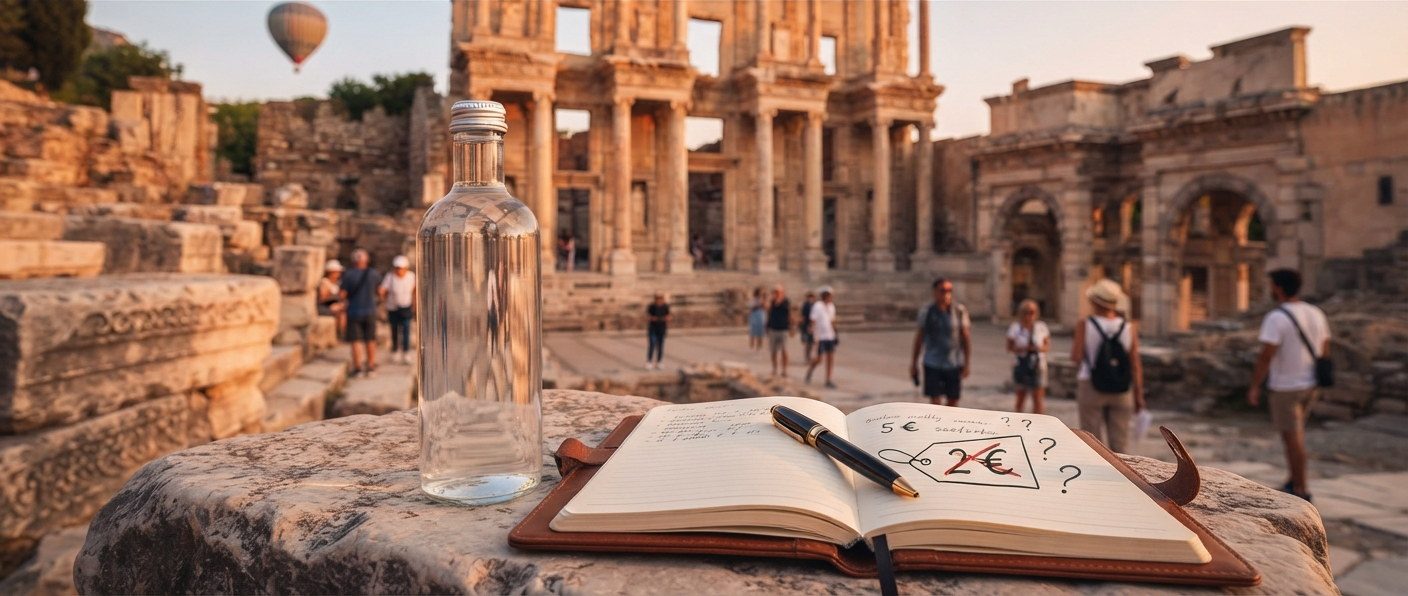
A tourist will happily pay five euros for a bottle of water.
I have watched people do it on the terrace at Pamukkale, at the gate of Ephesus, on the ferry to Büyükada. Nobody checks. Nobody compares. It is hot, the water is cold, and five euros is what a bottle of water costs when you are on holiday and someone else is carrying your luggage.
What the same person will not do is pay two euros for it today and five euros for it tomorrow, in the same shop.
That is not a small distinction, and I think our industry keeps missing it. We argue about whether Türkiye has become expensive. I would like to argue that expensive is not the variable that is hurting us.
The number everyone quotes
In August 2026, annual consumer price inflation in Türkiye was 31.51 per cent. Month-on-month it was 1.84 per cent — which, if you annualise a single month, is roughly what the euro area does in a year. The twelve-month average sat at 31.79 per cent.
In the same month, annual inflation in the euro area was 3.2 per cent. Greece 3.7. Spain 4.6. Italy 3.2. Portugal 3.6.
So the competitive set we are measured against is running at somewhere between a tenth and a seventh of our rate.
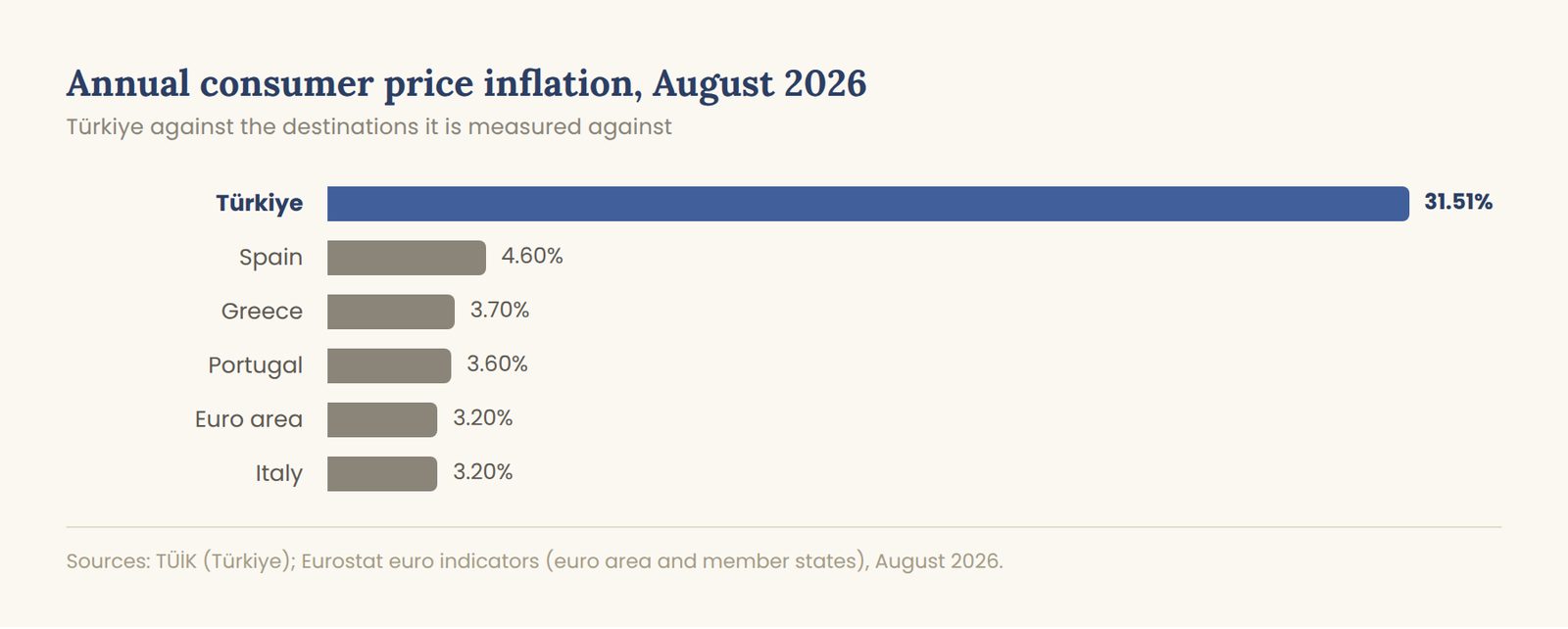
That is the number that gets quoted at every panel, in every trade article, in every conversation with a foreign partner who wants to know whether Türkiye is still good value. And the conversation that follows is almost always about the price level: are we cheaper than Greece, are we still cheaper than Spain, has the gap closed.
The number almost nobody quotes
Here is the figure I find more interesting.
In the first half of 2026, Türkiye received 24.84 million international visitors — 2.7 per cent fewer than in the same period of 2025. Tourism income was 25.75 billion dollars, essentially flat, down a tenth of a per cent. And average spending per visitor rose 2.5 per cent, to 1,020 dollars.
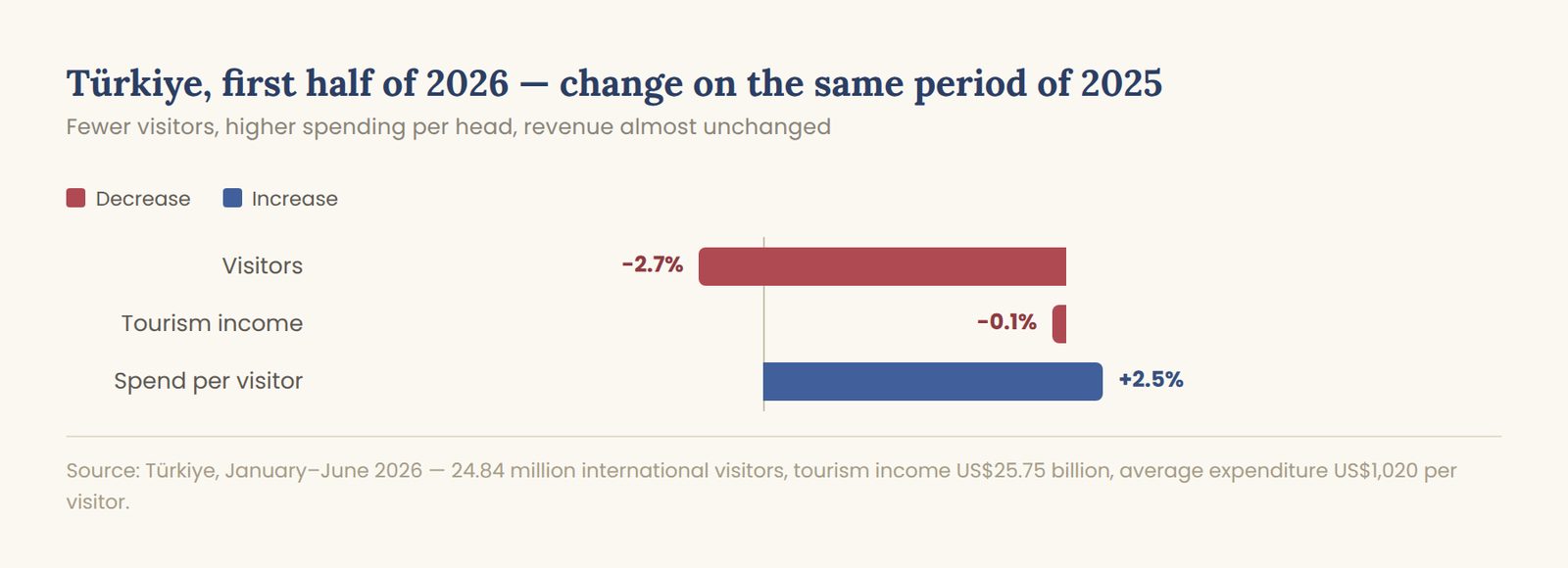
Read those three together. Fewer people came. The ones who came spent more. Revenue held.
If the problem were simply that Türkiye had become too expensive, we would expect the opposite pattern: arrivals holding up among price-sensitive travellers while spending per head falls as people trade down. What we actually have is a market that is shedding visitors at the margin while the remaining ones spend more.
I want to be careful here, because this is where a confident sentence would be dishonest. A 2.7 per cent decline has many possible fathers. Regional instability prices into destination choice. Exchange rates move differently for a German traveller than for a Nigerian one. Competitors invest. Weather, flights, fashion. Nobody should read a single half-year figure as proof of anything.
But it is at least consistent with a different diagnosis from the one we usually reach for.
What the traveller actually experiences
A visitor arriving in Antalya or İzmir does not experience an inflation rate. They cannot feel 31.51 per cent. What they experience is a series of small, concrete moments in which the price of something does not match the price they had in their head.
The guidebook said one thing. The blog post from last spring said another. The taxi that cost this much on Tuesday costs that much on Friday. The restaurant two doors down charges differently for the same plate, and neither of them is wrong — they simply updated their menus in different weeks.
Each of these is trivial on its own. The problem is what they do together. They convert every ordinary purchase into a small decision that requires attention. Is this fair? Should I check? Am I being taken advantage of because I am a foreigner, or is this simply what things cost now?
That last question is the expensive one, because the traveller usually cannot tell the difference, and the suspicion is corrosive in a way the expense is not.
Holiday is a state of not having to decide. It is the one product where the absence of vigilance is the thing being purchased. A destination that requires constant small acts of vigilance is taxing its visitors in a currency that does not appear in any price index.
Five euros for water is a price. Two euros yesterday and five euros today is a warning.
What it looks like from inside
I run ground operations. Let me describe the same problem from the supply side, because this is where it stops being an essay and starts costing money.
When we build a programme for a group travelling next spring, we are quoting a price now for services we will buy in seven or eight months. Hotels, coaches, guides, entrance fees, meals. In a stable-currency country this is ordinary commercial life; you contract, you hold, you deliver.
Here, a hotel that quotes a lira rate twelve months out is taking a position on inflation, and hotels are not in the business of taking positions on inflation. So they do one of three things. They quote in euros or dollars and push the currency risk onto their own cost base. They quote in lira with an escalation clause, which means the number in your file is not a price but an estimate. Or they decline to quote that far out at all, which is more common than foreign partners realise.
Every operator selling Türkiye is managing that. The ones who manage it badly do it by quoting optimistically and then going back to the client with a revision. And that revision — a single email, six weeks before departure, explaining that the price has moved — does more damage to the reputation of this country as a destination than any absolute price level ever has.
Because now the travel agent in Oslo or São Paulo has learned something about buying Türkiye: the number is not the number.
The thing we are actually selling
Our own answer to this is not clever. It is only deliberate.
We price in hard currency, and we hold the rate once a deposit is received. Before that point the rate can move and we say so plainly. After it, the number in the client’s hand is the number they pay, and the difference between what we quoted and what our costs do in the meantime is our problem, not theirs.
That is not generosity and I would not want it read as such. It is the transaction: we absorb the volatility, and what we sell back is certainty. For a group leader who has to stand in front of forty people from their parish and tell them what the trip costs, certainty is worth considerably more than a discount.
Which is the argument in one line. When a destination cannot offer predictability at the level of the individual purchase, somebody in the chain has to manufacture it. If nobody does, the traveller manufactures it themselves — by choosing somewhere else.
What I think we should be measuring
If I could change one thing about how we discuss competitiveness, it would be to stop leading with price level and start looking at price dispersion and price stability at the point of sale.
How far apart are the prices for the same cup of coffee within two hundred metres of a major site? How often does a published price change within a season? What share of accommodation will contract a fixed rate nine months out? How many bookings involve a post-confirmation price revision, and how many of those clients return?
I do not have those numbers. As far as I can tell, nobody is collecting them systematically for this country, which is a shame, because they would tell us something our headline inflation rate cannot.
We know we are cheaper than Spain. That has never been the question.
The question is whether a person who books Türkiye in February can say, in June, that they paid what they expected to pay. And in an economy running at thirty-one per cent, that is not something the market will produce on its own. It has to be built, deliberately, by the people in the middle.
Sources
Inflation, Türkiye. Turkish Statistical Institute (TÜİK), consumer price index, August 2026: annual 31.51 per cent, monthly 1.84 per cent, twelve-month average 31.79 per cent.
Inflation, euro area. Eurostat euro indicators, August 2026: euro area annual inflation 3.2 per cent; Greece 3.7, Spain 4.6, Italy 3.2, Portugal 3.6.
Arrivals, receipts and spending. Türkiye, first half of 2026: 24.84 million international visitors, down 2.7 per cent year on year; tourism income 25.75 billion dollars, down 0.1 per cent; average expenditure per visitor 1,020 dollars, up 2.5 per cent.
On the limits of this reading. The correlation drawn here between price unpredictability and the decline in arrivals is an argument, not a finding. A half-year change of 2.7 per cent is well within the range that regional conditions, currency movements in individual source markets, and competitor activity can explain on their own. I have set out the mechanism I believe is at work and the evidence I have; the measurement I am asking for — dispersion and stability at the point of sale — is precisely the evidence that does not yet exist.