
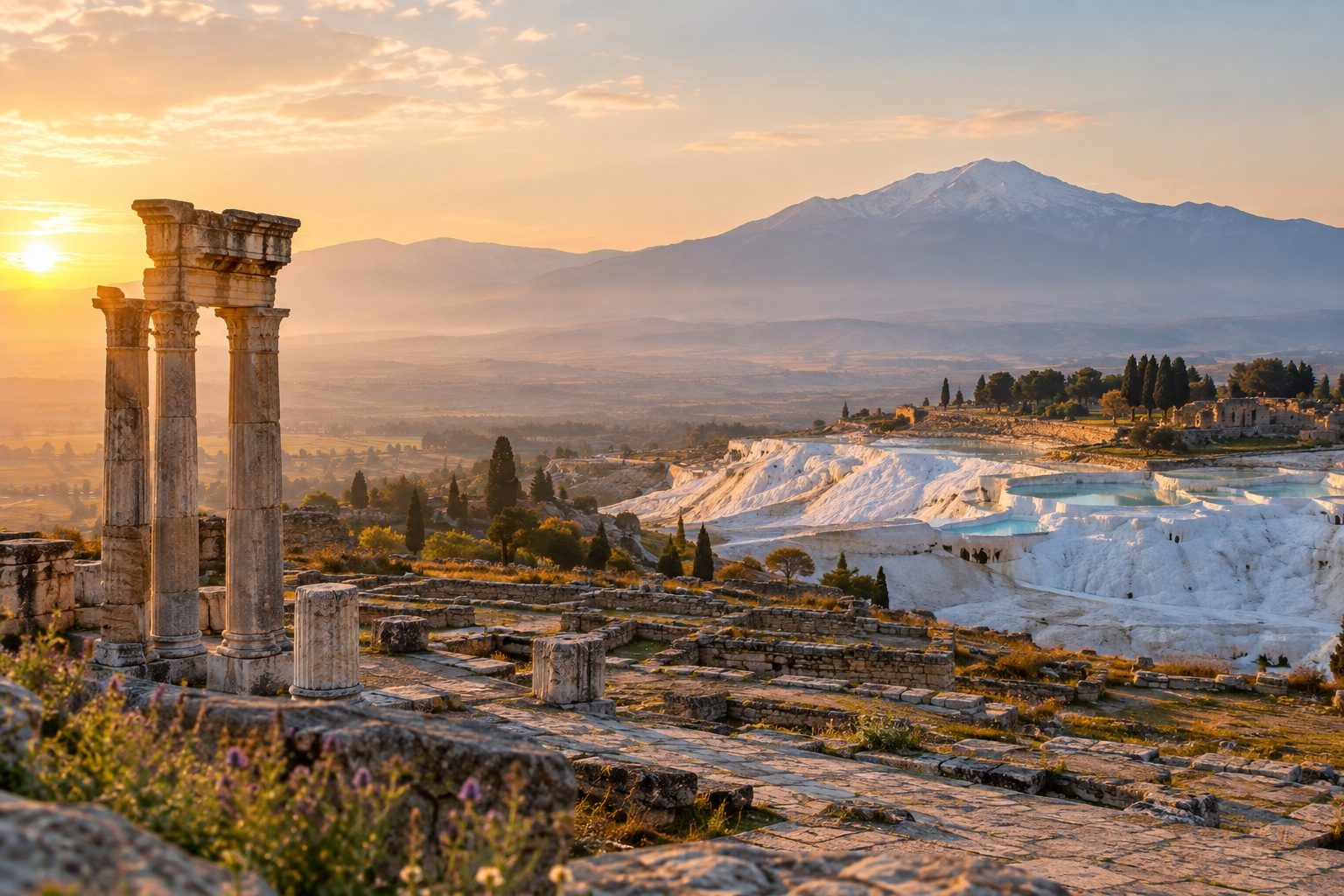
Our office is ten minutes from one of the seven churches named in the Book of Revelation. Hierapolis is twenty minutes beyond it; the mound of Colossae, half an hour away. In the fourth chapter of the Letter to the Colossians, Paul mentions the three cities together (Col 4:13), and asks that his letter be read in Laodicea as well (Col 4:16).
For me that is not a piece of tourist information. Every morning, on the way to work, I drive through a verse, and after ten years I still have not managed to make it ordinary.
They say you stop seeing what is in front of you every day. My experience has been the opposite: the more I see it, the better I understand how quietly this place keeps itself from anyone arriving from far away.
First there was a voice
The letters we hold in our hands today were not written to be read, but to be heard. The texts that reached Colossae, Laodicea and Ephesus were read aloud in the middle of the assembly; most of those listening could not read. To stand beside a stone and run through the text in silence is, strictly speaking, foreign to the original form of that text.
Anyone who has not heard, one morning, how a few lines sound read aloud among the ruins of Laodicea has not entirely arrived here. When the wind drops, the voice stays on the stone. It is difficult to describe; whoever has been there knows it.
The lukewarm water
What Revelation says to Laodicea is harsh: neither cold nor hot, merely lukewarm.
Behind the image lies a real geography. Twenty minutes to the north, the boiling water of Hierapolis still steams over the white terraces. To the southeast, at the foot of Mount Honaz, the springs of Colossae were cold. Laodicea, by contrast, had no water of its own: it brought it from springs to the south, along an aqueduct whose course archaeology has traced, through clay pipes that survive, calcified on the inside.
Since the nineteenth century, commentators have read the phrase as a blow aimed at the city itself: you are neither the heat that heals nor the cold that relieves, you are a water that loses its quality on the way. Not everyone accepts the reading — the scholar Craig Koester points out that some ancient visitors praised the water of Laodicea. The undisputed fact hurts just as much: a city proud of its wealth imported even its water.
Thought through one morning in Denizli, beside the remains of the aqueduct, that sentence stops being a footnote. I realise the text is not speaking to me: it is speaking to the ground I am standing on.
The tomb of Philip
Hierapolis sits directly above the travertines. On the hill stands the martyrium of Philip, and beside it a Roman tomb of the first century which the Italian archaeological mission identified in 2011 as the apostle’s. The identification is not settled — specialists continue to argue whether the Philip buried here was the apostle or the evangelist of Acts — and the relics are no longer there, since tradition places them in Constantinople from the sixth century onwards. The place of memory, however, is still this one.
Every day thousands of people walk over the white waters at the foot of the hill where, according to tradition, Philip ended his days. Most leave without knowing what is above them. I do not say this as a failing, but as a silence: there is a tomb, and the crowd walking below does not know it.
Those who do go up, moreover, tend to go up alone. The stair is steep, there is little shade, and on arriving at the top there is almost never anyone. To be alone beside the tomb of an apostle is, in this region, easy to arrange and rarely sought.
The language that came back
Colossae lies today in the district of Honaz. For most of its history nobody dug it — until 2025, when the first archaeological excavations in the site’s history began. As it is not a site with an entrance fee, no record of visitors is kept either.
In the neighbourhood of Hisar, in that same district, live the descendants of the families who arrived from Grevena with the population exchange of 1923. A century later they preserve their culture, and Greek has continued to be spoken among them.
It is worth pausing for a moment. In the present-day district of the city to which Paul wrote a letter in Greek, that same language is still heard — and not through the community that carried the text, but through another entirely different one, arriving nineteen centuries later and in the opposite direction.
That neighbourhood is not a stage set: it is the home of a group of people, and it must remain so. But to pass through a place knowing this is not the same as passing through without knowing it. In the second case the road grows shorter; in the first, it grows deeper.
White garments and eye-salve
There is another sentence addressed to Laodicea: buy white garments to cover yourself, buy salve to anoint your eyes.
Commentators usually read another local irony here. Laodicea was famous for its black wool textiles and for its medical school, where an eye-salve was prepared from what was called Phrygian powder. The text would then be offering the city precisely what the city produced, in order to tell it that this was of no use to it.
In this same land the textile tradition has not been interrupted. The weaving of Buldan continues, and some of the looms are still inside the houses. For a pilgrim that means something concrete: the industry that appears in the text is still working thirty kilometres away.
The table and the silence
What stays in the memory, in this region, is almost never the stone.
The table of a producer in the vineyards of Çal or Güney. A neighbourhood eating house, open at midday, that is not waiting for coaches. The glass a woman offers at the door, newly back from the oven with her bread. None of that is a point of sale: it is the city’s own life, and the guest is admitted into it for a while.
For a pilgrim coming from far away — for a group that has flown fifteen or twenty hours from Latin America — the mark left by an hour at a table is no smaller than the one left by ruins. Memory records the place not only with the eyes, but with the taste, the smell and the face it met.
And this does not replace worship. It is added to it. Pilgrimage is reason enough in itself, and nobody should dilute it inside a cultural programme.
What does not fit in an itinerary
Taking someone sightseeing is easy. Coach, hotel, tickets: many people can do it, and do it well.
The difficult thing is something else: arranging the silence and the time needed for whoever arrives to be able to pray here. Being in the right place at the right hour. Staying fifteen minutes inside a ruin after the crowd has gone. Sitting at a table without anyone hurrying you.
None of that appears in an itinerary, and yet it is what people take home with them.
Pamukkale, as it appears on the map, is only the image of this place. The city underneath — the tomb of Philip, the mound of Colossae, the looms of Buldan, the Greek of Hisar — does not appear on the postcard. And in the end the water always returns: an ordinary morning, beside the aqueduct, with the winter sun still low.
A note on this text
This article first appeared in Spanish on TurismoReligioso.travel, at the invitation of Miguel Ángel Cabrera. The Spanish original is here:
My thanks to Miguel for the invitation, and for the care he took with the text — including the correction on the families of Hisar, which I only got right because he pressed me to check the sources.
References
Revelation and the Letter to the Colossians. Revelation 3:14–18 (the lukewarm water, the white garments, the eye-salve). Colossians 4:13 and 4:16 (the three cities named together; the letter to be read in Laodicea).
The water of Laodicea. The aqueduct and the calcified clay pipes are documented by the excavations at the site. On the debate over the reading, see Craig R. Koester’s work on Revelation, which notes that some ancient visitors spoke well of Laodicea’s water.
The tomb of Philip at Hierapolis. Identified in 2011 by the Italian archaeological mission at Hierapolis (Missione Archeologica Italiana a Hierapolis di Frigia). The identification remains debated among specialists; the relics are traditionally placed in Constantinople from the sixth century.
Hisar, Grevena and the population exchange. On the mübadil settlement in Honaz, see Ali Haytoğlu, Denizli-Honaz’a Yapılan Mübadele Göçü, ÇTTAD (Dokuz Eylül University). The municipality of Honaz records that sixty-nine of eighty-two households came from Vraşno and Kastro in the kaza of Grebene, vilayet of Manastır, and that Hisar was the Greek quarter emptied in 1924: https://www.honaz.bel.tr/icerik/honaz-tanitim — The Vallahades were Greek-speaking Muslims of the Grevena and Anaselitsa region, resettled in Anatolia under the 1923 exchange.